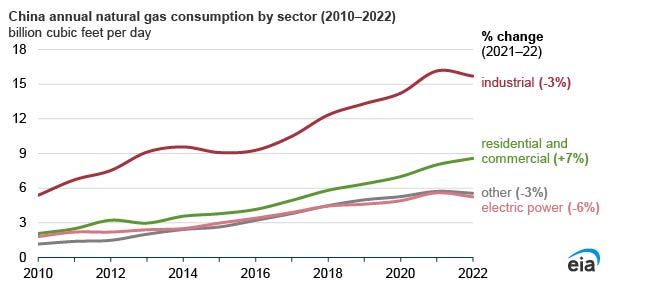
In 2022, annual natural gas consumption in China declined by 1%, or 0.4 billion cubic feet per day (Bcf/d), from 2021, according to data from S&P Global Commodity Insights—the first decline in annual consumption since 1990, according to our International Energy Statistics. Slower economic growth, mainly resulting from widespread lockdowns associated with China’s zero-COVID policies, prompted the drop in natural gas consumption. Government policies also reprioritized energy supply security, including growth in coal production, over emissions targets.
China’s natural gas consumption more than tripled from 10.4 Bcf/d in 2010 to 35.1 Bcf/d in 2022. The industrial sector led China’s natural gas consumption growth during this period, increasing by 10.3 Bcf/d, followed by the residential and commercial sector at 6.5 Bcf/d and the electric power sector at 3.4 Bcf/d. Strong economic growth, urbanization, and environmental policies supporting coal-to-natural gas switching in an effort to reduce air pollution and meet emissions targets all contributed to rapid growth in China’s natural gas consumption over the last decade.
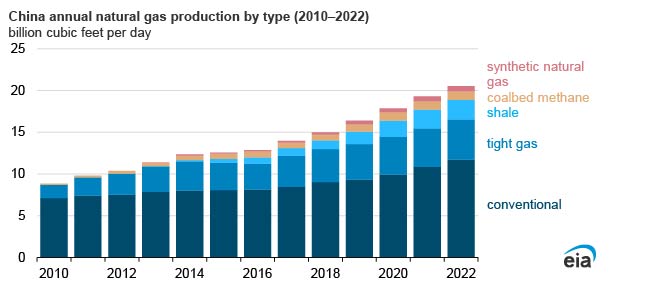
Despite significant growth in domestic natural gas production, China has become increasingly dependent on imports because growth in demand has outpaced growth in domestic production. Natural gas imports (combined pipeline and liquefied natural gas [LNG]) accounted for 46% of China's total natural gas supply in 2021 and 42% in 2022, an increase from 15% in 2010.
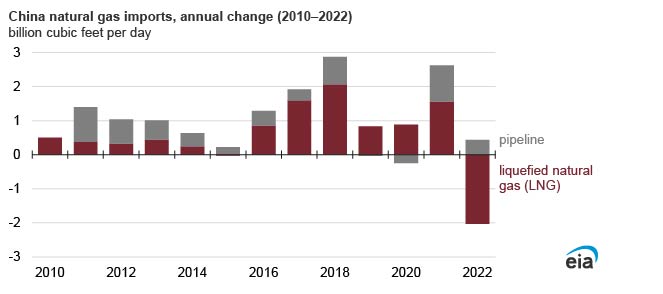
After becoming the world’s largest LNG importer in 2021, China’s LNG imports fell by 20% (2.0 Bcf/d) in 2022, mainly because of reduced demand and relatively high LNG spot prices. China’s LNG imports averaged 8.3 Bcf/d in 2022—the least since 2019, according to data from China’s General Administration of Customs. In 2022, imports by pipeline offset some of the declines in LNG imports, increasing by 8% (0.4 Bcf/d) compared with 2021, mainly because of increased flows from Russia via the Power of Siberia pipeline.


