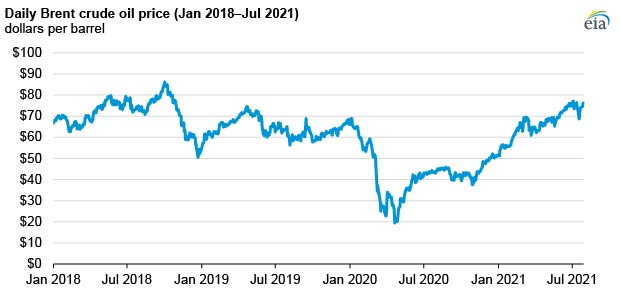
On July 18, OPEC+, which includes most members of OPEC and several non-OPEC members (including Russia), agreed to increase monthly crude oil production starting in August 2021. On July 19, after the new OPEC+ agreement was made public, the price of Brent crude oil fell 7% from the previous day to $69 per barrel (b). Since then, the price of Brent crude oil has been rising, reaching $76/b on July 30.
In early July, members of OPEC+ had adjourned without reaching a new crude oil production agreement, and front-month futures prices for Brent crude oil rose to $77/b on July 5, the highest price since October 2018. OPEC+ negotiations stalled because of disagreements between Saudi Arabia and the United Arab Emirates (UAE) on the baseline levels that the members’ production cuts should be measured against.
The agreement calls for the 400,000 b/d monthly increases to continue until the previous production cuts are fully reversed. However, OPEC+ extended the production agreement to include monthly meetings through the end of 2022 so that they can adjust production targets as necessary.
The most recent agreement did not specify monthly output targets, which leaves exact implementation uncertain. OPEC+ also agreed to raise the baselines for Saudi Arabia, Russia, the UAE, Iraq, and Kuwait by a combined 1.6 million b/d starting in May 2022; however, they did not specify how they would implement the new baselines.
Even before the latest agreement, our July Short-Term Energy Outlook (STEO) forecast a continued increase in OPEC production beyond July in response to rising global oil consumption. In the July STEO, we forecast that OPEC crude oil production would average nearly 3 million b/d more in the second half of 2021 than in the first half of the year. We will continue to monitor OPEC production and update its forecast in the next STEO release on August 10.


