
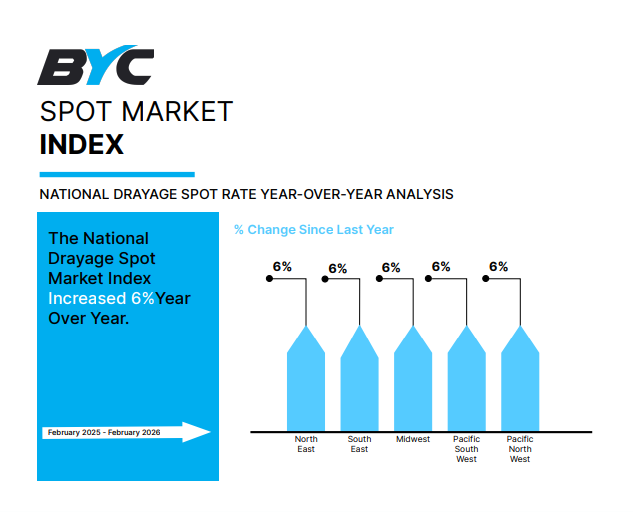
February opens in a freight environment defined less by volatility and more by caution and recalibration. Industry leaders report that the broader freight market is starting the year at a measured pace, with shippers prioritizing reliability and supply chain stability over aggressively pursuing lower rates. This reflects a broader industry shift as companies move toward controlled inventory strategies and predictable cargo flows instead of reactive shipping patterns. For drayage, the result is a market that feels balanced: capacity is generally available, and rate movement is moderate. National drayage rates have increased 6% year-over-year. Physical network developments continue to shape how cargo moves across North America. The Port of Los Angeles is pressing forward with an extensive construction and modernization program aimed at improving terminal performance and long-term throughput. At the same time, the Port of Long Beach is planning a new terminal designed to capture high-velocity e-commerce volumes and is exploring development of a conventional zero-emissions terminal model. While these initiatives point to significant future efficiency gains, active construction and evolving gate patterns can create localized friction in the near term, including longer turn times and shifting appointment dynamics. Beyond the West Coast, Canada’s Port of Saint John is positioning itself to handle larger vessels and higher container volumes, strengthening its role as an alternative gateway and adding resilience to the broader North American network. |
 |
Taken together, February’s market signal is one of stability supported by strategic groundwork. According to the U.S. Energy Information Administration, diesel now averages at $3.52 per gallon, down from $3.68 in February 2025 |


