
Modernization in China will revolutionize the country’s consumerism.
The purchasing power of both urban and rural consumers for fresh and packaged agriculture products combined with the rise of on-line food deliveries is creating opportunities to modernize China’s end-to-end cold chain capacities. Rural harvests of peanuts, Wangmang peaches, organic kiwis and apples are some of the items consumers purchase in stores, from mobile software applications (apps) and websites while cold storage logistics is striving to meet their demand. Lower developed inland cities of Xiangyang, near Wuhan city, in Hubei province and Xi’an, home to the ancient terra-cotta soldiers, in Shaanxi province are two cities gradually building cold chain infrastructures to 21st century international standards.
Most consumers have access to affordable smart phones in China where a simple lunch of noodle soup at a local restaurant are purchased without cash changing hands by the simple waving of the WeChat pay phone app to the restaurant or store’s two-dimensional bar code. This ease of doing business is transferring to perishables and for ordering groceries on-line with great potential for cold chain logistics. There are 350 million millennials in China. In 2018, the total amount of on-line sales was $1.306 trillion (9.01 trillion yuan), an increase of 23.9% over 2017, according to China Daily.
Mobile Cool Chain
At the Zhuyeshan Agriculture Products Trading Center in Xiangyang, Mr. Tang, manager, market operations, described the Taodaji mobile app ordering system. At 4 a.m., agriculture products arrive from the fields for distribution of food to the area hotels, schools and supermarkets. The Taodaji workers see the orders on-line and find the items in the wholesale market distribution area here. At the same time, 70-80 trucks line up for delivery to the city area customers by 8 a.m. Huolala is a mobile app that registers truckers to come and handle the logistics of fulfillment or Taodaji uses their own trucks. Zhuyeshan has a modern testing laboratory to check for pesticides residue that prints a report to show customers certification and traceability. The test can be done for imported bananas from the Philippines, Vietnam and Myanmar via Guangdong by in bond refrigerated containers (reefers) which are held in refrigerated areas on site. Pricing and quality are combined wherein the costs are the agriculture item plus order fulfillment and logistics delivery, then a 2-3 day waiting period after delivery to ensure quality before payment is received from the satisfied customer. Only 10% of business is through Taodaji, but a new platform is to be expanded to increase on-line sales in Zhuyeshan.

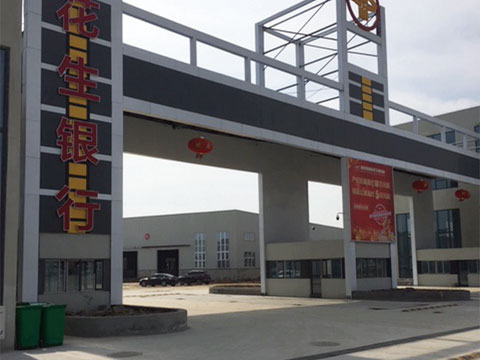
Nearby, the Xinfadi International Peanut Trading Market requires refrigeration from May to August. Xianyang peanut farmers are 50% of the entire Chinese productive market. Xinfadi has an agriculture cooperative in all of China to monitor quality and are building 100 warehouses to meet surging domestic and international demand. Director Xu explained that “our site opened in 2015 and we are 80% occupied with 40,000 square feet of warehouse space. Our Peanut Bank can pay growers 80% for storing here because of high demand and excellent cash flow in all of China and to international markets. One customer exported $145 million (1 billion yuan),” he exclaimed.
The capital and operating costs of a new cold warehouse are expensive. Xinfadi estimates are $43.5 million (300 million yuan) for one warehouse and they plan to build 100 in China. They are investigating the use or renting of refrigerated container operations for storage areas to defray their construction and operating costs. The warehouse network is supported by a modern infrastructure system in the cloud and with real-time pricing monitors displaying a variety of data on-site in the main office area.
The increasing on-line food delivery business and demand for fresh, chilled and frozen foods caught the attention of international grocery chains, Metro and Walmart in Xiangyang. They are finding competition from local supermarket chains, on-line only fresh grocery providers such as Maicai, and on-line giants such as JD.com, 7FRESH supermarkets and Alibaba, Hemashengxian supermarket chains. Metro, based in Germany with China headquarters in Shanghai, contracts with Henan province based Shuang Hui for “the best cold chain experience in China,” according to Wu, manager, Metro, Xiangyang, in a recent interview. Shuang Hui is a sausage and meat company. They have a proven cold chain system with refrigerated trucks all over China and good practices to unload from trucks at the stores without the loss of temperature. “Local logistics companies lack the temperature sensitive knowledge and of on-time-delivery (OTD), door-to-door services and hydraulic lift trucks,” she said. Walmart announced an investment of $1.2 billion in China over the next 10 years to upgrade logistics involving 10 logistics centers and the “smart retail” environment, according to the Wall Street Journal in July.
Further north is Xi’an, Shaanxi province where a new, over $200 million, Shaanxi Logistics Port is in the works that will construct a modern cold chain warehouse. Farms are organizing in cooperatives and in hundreds of modern agriculture parks all over Shaanxi for packaging and branding high quality fruits such as apples for markets along the Belt and Road Initiative’s (BRI) New Silk Road. Some of these agriculture enterprises are selling on the Taobao platform already.
A Modern Xi’an
Twenty-five years ago, Xi’an was a desolate, dirty and backward city and now modern shopping centers, office and apartment buildings, wide highways and supermarkets chains as well as Starbucks and KFC highlight a bustling metropolis. Xi’an’s foreign trade was up 29.58% in 2018 over 2017 to $48.8 billion in value. Trade with the United States was up 17.5% and use of foreign direct investment increased 19.7% to $6.35 billion in 2018. Xi’an is becoming a key transport terminal in BRI trade where Xi’an Customs launched 1,235 China-Europe freight trains in 2018 for 1.2 million tons of goods at $1.72 billion, according to Shaanxi statistics reports.
However, cold chain logistics needs modern operations and infrastructure to catch up with international practices and standards in food safety, temperature-control technologies, training and profitability. In addition to the new cold chain facility of the Shaanxi Logistics Port project in Xi’an, another 300,000 tons cold storage park and a test bed of cold chain logistics is underway. Yangling city, 43.4 miles (70 kilometers) from Xi’an aspires to become the largest cold chain logistics to Northwest China near the Eurasia rail freight line.
Yangling is the only agriculture high-tech demonstration zone with much government support. Since 2011, the Yangling Modern Agriculture E-commerce Industrial Park underpins the improvements of rural farmers quality of produce to meet international standards. Shengnong Logistics Company is testing modern technologies to demonstrate to Shaanxi and nationally the importance of agriculture cold chain technologies.
Zhai, owner of Shengnong Logistics, showed their facility equipped with an array of European imported and installed infrastructure and even agriculture seedlings to improve farmers’ quality. Among these were Italian cold chain walls that are five times more expensive than normal walls, French air conditioning equipment, a Netherlands designed facility of 60 doors of which each with 150 tons capacity as well as equipment to control carbon dioxide levels with nitrogen to preserve freshness of agriculture produce and flowers.
“We rent space to Alibaba, JD.com and SF Express to package and store Xinjiang pears and apples for e-commerce orders to be delivered to customers all over China,” said Mr. Zhai.


