California’s progressive zero-emission vehicles’ regulations, robust public funding and incentive ecosystem are jolting the Port of San Diego into action. The San Diego Port Tenants Association (SDPTA) is demonstrating 7 of 10 electric vehicles (EV) by Port Tenants: Dole Fresh Fruit, Marine Group Boat Works and Pasha Automotive Services. Advanced technologies are expensive and full commercialization of operations are years away, therefore the California Energy Commission (CEC) granted $5.9 million as an incentive to the SDPTA members to prove the feasibility by this demonstration project.
The Port of San Diego is at the forefront of California’s initiative over the past eleven years to control the air pollution associated with the movement of goods. In 2011-2012, California’s freight sector accounted for nearly half of diesel particulate matter, 45% of the nitrogen oxides (NOx), six percent of the green-house gas emissions in the State, according to the California Energy Commission. In order to mitigate these environmental hazards, CEC’s Clean Energy Program, known as Alternative and Renewable Fuel and Vehicle Technology Program (ARFVTP), began in 2008 by AB 118 (Nunez, 2007).
ARFVTP invests up to $100 million per year in project areas to advance the state’s goals on climate change, air quality and zero-emission vehicle adoption and deployment. Among these investments are California’s West Coast Electric Highway which are a network of direct current (DC) fast chargers from Baja to British Columbia, construction of dozens of retail hydrogen fueling stations and deployment of numerous alternative fuel and zero-emission vehicle and equipment technologies, according to SDPTA in a recent interview with the American Journal of Transportation. Furthermore, Port of San Diego is one of five California ports involved in the former Governor Brown’s July 2015 Executive Order (B-32-15) to develop and implement the California Sustainable Freight Action Plan and the Ports Energy Collaborative for opportunities in transitioning to alternative and renewable energy technologies.
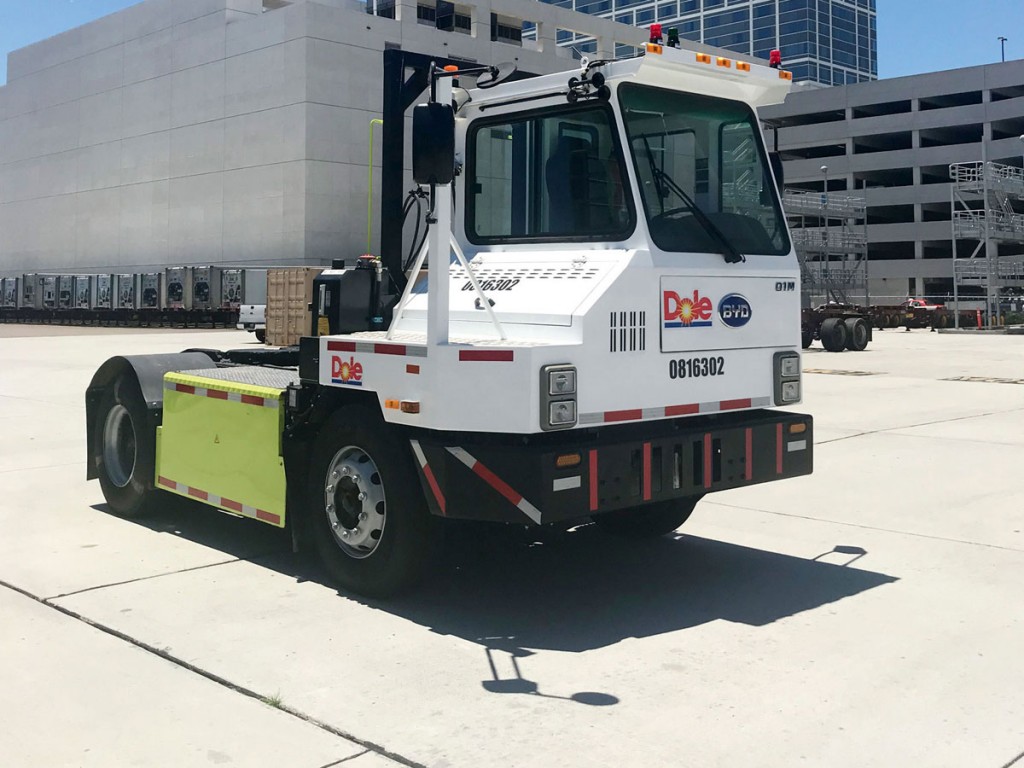
The $5.9 million grant from ARFVTP is an important incentive to several tenants of SDPTA. “Seven of the 10 electric vehicles are being demonstrated by three of our Port Tenant-End Users,” said Chelsea Bernie, Special Projects, SDPTA. Dole Fresh Fruit is demonstrating 2 Build Your Dream (BYD) class 8 yard trucks at the Tenth Avenue Marine Terminal. Marine Group Boat Works, LLC, a family owned full-service boat and super yacht refit and repair facility, is demonstrating 2 Cummins 12,000 pound electric forklifts. Pasha Automotive Services (PAS), a family-owned global logistics and transportation company at the Port’s National City Marine Terminal, is demonstrating one BYD class 8 yard truck and two BYD class 8 drayage trucks. The two drayage trucks are used to shuttle newly imported cars on a flatbed trailer from the Terminal, while the yard truck is an off-road utility vehicle for various yard operations.
All the demonstrations are going as planned and the overall comments for the project are positive. Ms. Bernie remarked, “The development period for each of the vehicles provides the opportunity for each demonstrator to give feedback on changes and modifications to the EVs to suit their needs. This is a valuable aspect of the grant-funded demonstration projects allowing the original equipment manufacturer (OEM) to get detailed information from potential customers.” Later this year, HII San Diego Shipyard Inc., a repair facility to the United States Navy warships, will demonstrate a 40,000-pound forklift from TransPower; and Terminalift, a specialized cargo handling company owned by General Dynamics NASSCO, will demonstrate two class 8 drayage trucks by an OEM vendor to be named later.
Time Gap
There could be a gap of years between the demonstration period of these new EVs and the commercial production because of the cost of the EVs and their supporting infrastructure for electric charging. Short-range hauling operations are more feasible at this stage of the transition from diesel powered internal combustion engine vehicles. The regulatory environment in California allows for the long transition period over the next 15-20 years for near-zero and zero emission technologies.
“Trucking companies need to know that an electric drayage truck can do the job that its diesel counterpart is able to do. If it cannot go the range that the operator needs, it won’t be useful. If it costs 20 times more, that’s a big problem. Right now, a pre-commercial class 8 electric drayage truck is around $300,000 plus taxes and there is a need for infrastructure,” said Philip Gibbons, Program Manager for Energy and Sustainability, Port of San Diego in a recent interview with AJOT. Electric is only part of the solution since natural gas trucks have low nitrogen oxide engines and there is hydrogen for long range trucking but, “costs will need to come down.”
BYD, based in China, is the technology provider for 5 of the 10 demonstration vehicles and their production facility is in Lancaster, California. BYD finds that a large part of the challenge of charging stations is identifying available power at facilities or purchasing additional capacity which is costly. Standards are being codified for heavy-duty charging to offset the issues of proprietary chargers working with other equipment. BYD stated that their technicians are available for this project for all maintenance and repair and that vehicles are under factory warranty of 2 years of bumper to bumper, 3 years for powertrain, and 5 years for the battery.
“California at the state and local levels has the most robust public funding and incentive ecosystem in the Americas for the development and deployment of advanced clean energy and transportation technologies and is also supported by periodic investments by the federal government,” emphasized Ms. Bernie. These include CEC, California Air Resources Board, California Department of Transportation and the federal departments of Energy, Transportation, Maritime Administration and Environmental Protection Agency. At the local level there is important funding and incentive opportunities presented by utility investments.
Gibbons explained that “there are state incentives to drive down these costs.” For example, the California Hybrid and Zero-Emission Truck and Bus Voucher Incentive Project (HVIP) provides a voucher of $150,000 towards the purchase of a BYD truck. Also, San Diego Gas and Electric has a Senate bill 350 application into the California Public Utilities Commission (CPUC) to include covering certain costs of the installation of electric vehicle charging equipment.
Finally, SDPTA is also responsible for administering the ARFVTP grant toward an Intelligent Transport System (ITS) component. The original scope of work (SOW) from CEC was to include both platooning and Freight Signal Priority (FSP) technology. Platooning is to enable freight trucks to synchronize their cruise control for trucks to follow other trucks closely enough to reduce air resistance and save on fuel. However, the SOW has been amended since “commercial deployment for the platooning is no longer feasible in the originally scoped area and the focus is now solely on the FSP.” The FSP project will install technology into approximately 15 intersection signals along Harbor Drive connecting the Tenth Avenue Terminal with the National City Distribution Center. Four Seasons Trucking is partnering on this aspect of the project to coordinate the fleet demonstration and STC Traffic is the major subcontractor facilitating the installation and implementation of all technology and infrastructure.


