For Brambles, sustainability is nothing new, it has been the company’s business model since 1958. The company’s unique handling of pallets points the way not only to sustainable practices but to the logistics potential of Big Data.
An Australian company has constructed a thriving global logistics business and gained a glittering international reputation for sustainable practices with that most basic of freight-related implements — the pallet.
“Reuse different than recycle. If you want to amplify that to the nth degree, you share it. It’s been our business model since 1958; it hasn’t changed,” said Sean O’Sullivan, Brambles vice president of investor relations and corporate affairs. “It’s the convergence of the circular and the sharing economy, getting the best of both worlds in terms of maximizing the use of assets.”
O’Sullivan met with American Journal of Transportation at Brambles’ headquarters, in Sydney’s city center. He was joined by Lachlan Feggans, the company’s director of sustainability.
Publicly traded, Brambles posted revenue of $2.856 billion and a net profit of $320 million for the first half of the fiscal year that will end June 30. Brambles was earlier this year cited by Barron’s magazine as second among the top 20 international sustainable companies.
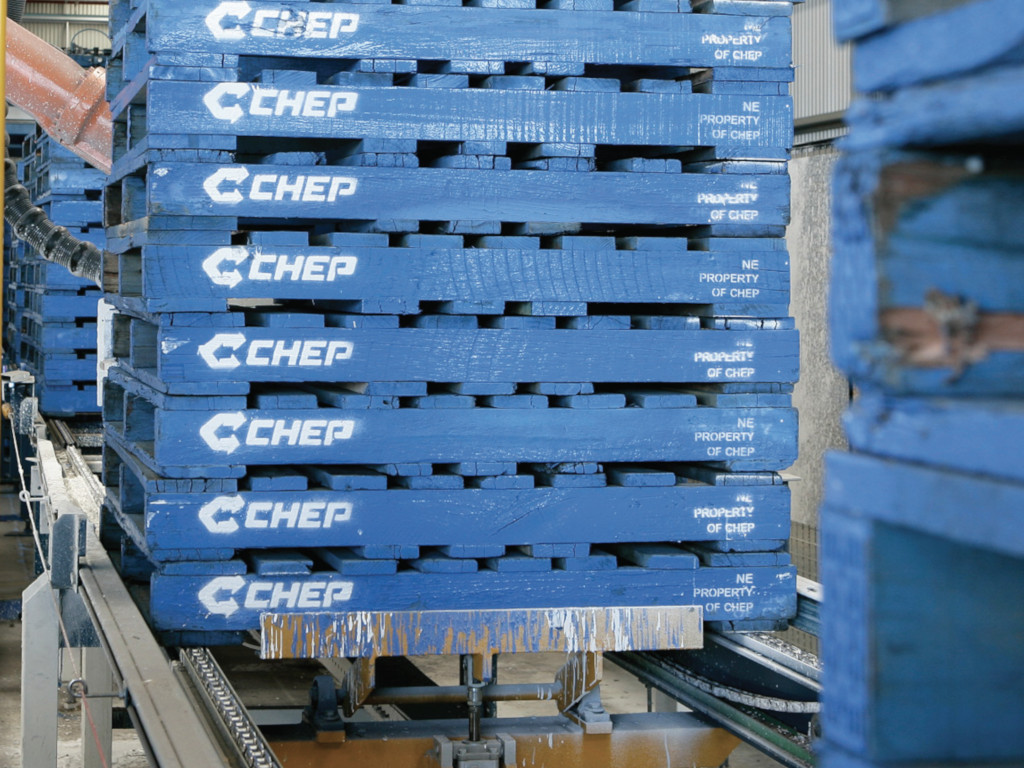
CHEP’s business works like this:
Manufacturers pay Brambles to access a set number of pallets, a charge called an “issue fee.” Manufacturers load the goods on the pallets, which are then transported to distribution centers and then to retailers. Brambles is responsible for delivering and picking up empty pallets, repairing any that are damaged and then placing them back in the pool-based system. Brambles now owns a tad under 300 million pallets.
Brambles sells manufacturers, and by extension, retailers on the simple proposition that they don’t need a single-use pallet to move goods through the supply chain system. Brambles has found that one of its pallets can last for ten years and be used, at least in Australia, for about three times a year, or 30 times in all. So, companies are able to piggyback on Brambles’ environmentally sustainable practice.
“That’s what our sustainability story is all about,” said Feggans. “You start to get really significant numbers using our pallets versus a single use. We can say to a Kroger, ‘use of our pallets in one year equates to saving X amount of carbon, X amount of tons of waste.’” Companies can use that data to underscore their own environmental savings.
Shared Pallets
Shipping containers offer the closest analogy to the Brambles model. The difference, though, is that each shipping line carries its own containers. Brambles, by contrast, dominates the shared-pallet industry. The only noteworthy competitor is PECO, which operates only in North America and which is far smaller. According to O’Sullivan, in the US, reusable pallets have about a 50% penetration rate. Of that, CHEP commands maybe four-fifths, while PECO has about one-fifth.
Brambles now operates in 60 countries under the CHEP brand. About 41% of its business is in North America, while 39% of its business is in Western Europe. The vast bulk of pallets are used for consumer-related goods including dry goods, fresh produce and beverages.
Most of the company’s growth is organic, that is, it builds new business rather than acquiring existing business. During the interview, O’Sullivan draws a chart that demonstrates a region’s penetration rate for reusable pallets versus the number of years such a practice has been in operation. They move up in tandem. Pioneers Australia and New Zealand are pretty much saturated, while in North America and Western Europe, about 50% of pallets in use are reusable. That usage drops precipitously in countries like China, India and Russia, which O’Sullivan termed “blue sky, embryonic at the moment, but with huge potential.”
One big problem in China, for example, is lack of uniformity. Pallets may be a different size in North America compared to Europe, but they are standardized so that two pallets equal the width of a truck and forklifts can move all pallets. But in China, neither trucks nor pallets are a standard size. That means workers must often load or unload boxes from pallets before they can be transported or stored.
Brambles believes that its business in China is destined to grow. “The supply chain costs in China are amongst the highest in the world, so they’ll want to get them down,” said O’Sullivan. “When that happens, this model will take off because it works. We can’t tell you when it will happen, whether it’s two years-time or eight years-time, we don’t know. But we’re well positioned.”
Core Business
Brambles recently announced that it had sold IFCO, its reusable plastic containers business, for $2.51 billion to private equity firm Triton and a subsidiary of the Abu Dhabi Investment Authority. The transaction should close this quarter.
The IFCO sale marked a renewed emphasis on Brambles’ core business, O’Sullivan said. IFCO has accounted for less than 10% of the company’s total revenue. Brambles, however, will retain its reusable plastic containers operations in Australia and New Zealand.
The origin of the pallet business is unique. American forces in World War II staged the Asia-Pacific campaign from Australia. After the war ended, the US military left behind massive numbers of pallets, containers and handling equipment, which the Australian government took over. A decade later, Brambles acquired the Commonwealth Handling Equipment Pool, or CHEP, from the government.
With its distinctive blue-colored pallets, CHEP has gained a reputation for strength and durability. One Sydney-based warehouse manager of fasteners called them “the gold standard,” and said “we love when they come through.”
Brambles doesn’t manufacture its pallets. Nor does the company own the fleets of vehicles necessary for pickup and delivery. “We’re supplier agnostic,” said O’Sullivan. “We deal with all the major trucking companies in each region.”
That can lead to greater transport efficiencies, and not just in moving pallets. Brambles terms this “transport orchestration,” and it has begun to work with carriers and shippers in Europe. Brambles, which sits on a gold mine of data, knows that one company needs to move goods. It also knows that a particular truck, which has dropped off pallets, is now empty. So, it can play matchmaker. “We can match them up,” said O’Sullivan. “It’s a growing phenomenon as logistics is increasing but the efficiencies of loads are decreasing.”
Currently, CHEP pallets have no identifiers, not even barcodes. So, Brambles is now experimenting with technology to better track its pallets. According to O’Sullivan, these devices can simply allow the company to locate pallets or, with more sophistication, supply data on temperature, humidity and load. Right now, O’Sullivan said, the devices are too expensive for mass use, but the costs will likely come down in the future and will lead to more widespread application.


