
Facility expansions and enhancements are the order of the era at ports of Louisiana, with energy industries and byproducts (think petrochemical resins) fueling much of the growth scenario.
A number of Louisiana ports are extending their footprints, or at least aiming to do so, while also looking to make the most out of existing acreages.
Port of New Orleans
Marketed as Port NOLA, the Port of New Orleans attributes continuing double-digit growth in container volumes to factors including Panama Canal expansion, booming petrochemical resin exports and growing market demand for imports. The record 648,538 twenty-foot-equivalent units moved in 2019 represented a 10 percent increase over 2018.
A $100 million expansion plan is advancing to double throughput capability at the Napoleon Avenue Container Terminal, to include four new 100-foot-gauge gantries to efficiently work vessels in the 8,000-to-9,500-TEU-capacity range. The cranes are expected to be operational in mid-2021.
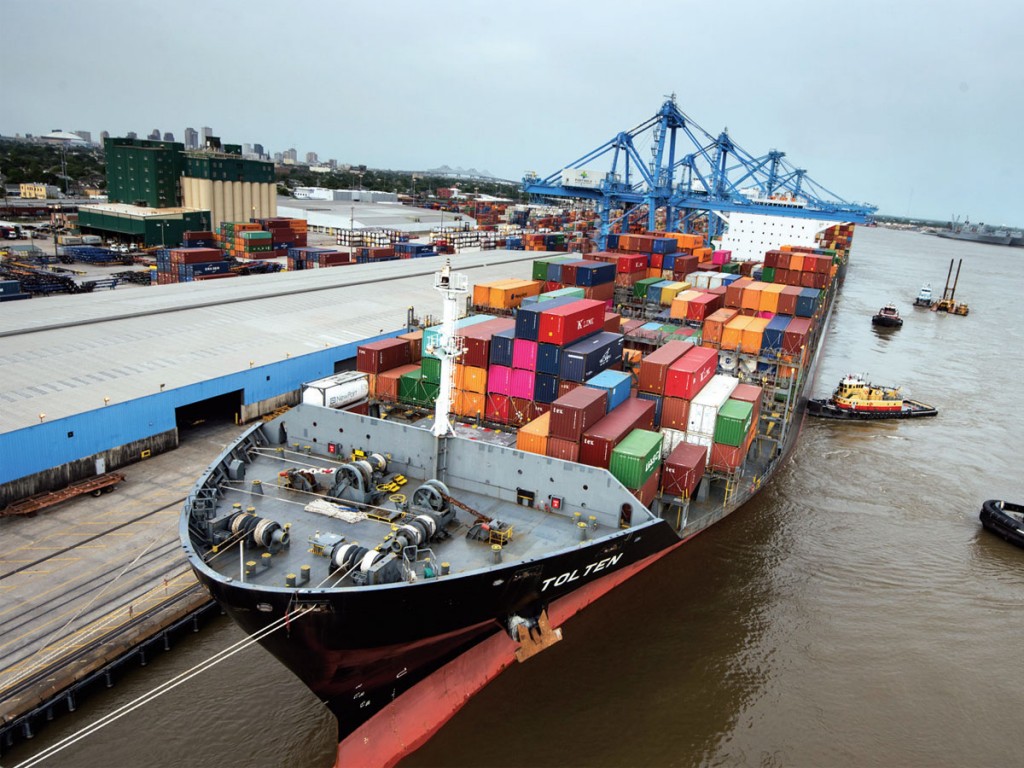
At the same time, Port NOLA is furthering progress on plans to build a second container terminal downriver, with intent to partner with top carriers and terminal operator Ports America. Officials hope this will broaden options to serve carriers and shippers of all sizes while providing ample space for value-added logistics services.
The port features 12 weekly container services from three major global alliances as well as independent carriers. Latest additions include Mediterranean Shipping Co.’s Lone Star Express, in which Maersk and Zim Integrated Shipping Services partner – the port’s second direct Asia service, in addition to CMA CGM’s PEX 3, with partners COSCO, Evergreen and OOCL. In February, Seaboard Marine launched a new all-water offering connecting North Central America with New Orleans.
Port NOLA has enhanced intermodal efficacies following 2018 acquisition of the New Orleans Public Belt Railroad short line, it is enjoying continuing success of container-on-barge service links with upriver Baton Rouge and Memphis ports, and it is further buoyed by the February announcement of inclusion in the U.S. Army Corps of Engineers 2020 work plan of more than $85 million to initiate deepening the lower Mississippi River channel to 50 feet.
St. Bernard Port
Just 9 miles downriver from Port NOLA’s Napoleon Avenue Container Terminal, the Chalmette Slip of the St. Bernard Port, Harbor & Terminal District is getting a much-needed rehabilitation. A summer reconstruction start is scheduled at the slip, which dates back more than a century. The $33 million project is getting a jumpstart from a $13 million federal Transportation Investment Generating Economic Recovery grant awarded in 2018, with state and port district coffers and terminal operator Associated Terminals combining to cover the rest of the cost.
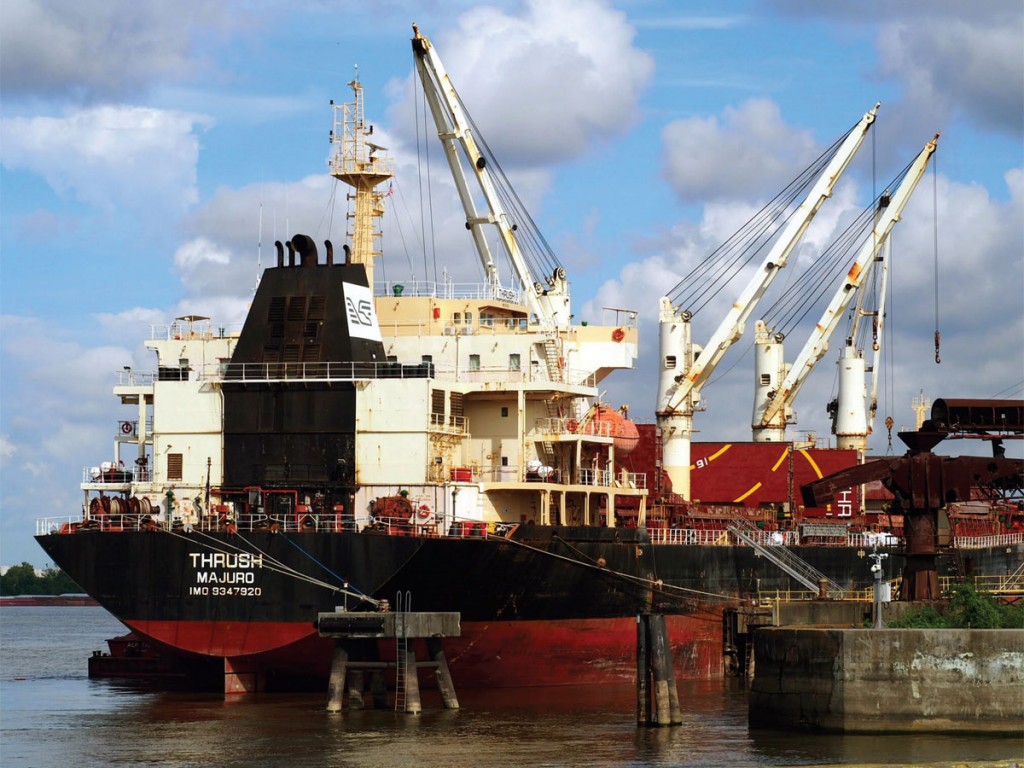
St. Bernard Port officials also are looking to grow the 216-acre Chalmette footprint, with 12 adjacent acres having been acquired and additional land being eyed for future expansion, including for logistics for sugar refinery operations and other warehousing. In addition, port leadership is negotiating with ASR Group, formerly known as American Sugar Refining Co., related to building of new warehouse space at Chalmette for storage of refined sugar products.
Meanwhile, St. Bernard Port’s four berths and four midstream mooring buoys are remaining busy with handling a broad spectrum of bulk materials, from fertilizers to metals.
Port Manchac
The South Tangipahoa Parish Port Commission’s Port Manchac is looking to complete this year the $3 million redevelopment of its 140-acre intermodal terminal on the northwestern shore of Lake Pontchartrain, northwest of New Orleans. The objective is to create a safe, efficient inland location for storage and transload of bulk, breakbulk, neobulk and containerized cargos, taking advantage of barge, rail and truck/highway assets in a relatively uncongested area.
Initial completed aspects of the redevelopment project include bulkhead, dredging, internal roadway, rail and drainage improvements, while those now being finished include storm surge protection barrier expansion, barge dock work and further paving, drainage and safety lighting enhancements. The redeveloped facility features a new 25,000-square-foot laydown storage pad – acclaimed for its use of permeable pavers – designed to handle anticipated future container transshipments from the Port of New Orleans and other Mississippi River installations.
Port Manchac officials are teaming with Canadian National Railway counterparts in marketing the site, which adjoins the CN mainline as well as Interstate 55, to leaders of the polymer pellet and resin manufacturing industry for storage and transloading operations.
Port of South Louisiana
Long-recognized as the No. 1 total tonnage port in the Western Hemisphere, the Port of South Louisiana, which encompasses 54 miles along both sides of the Mississippi River upriver from New Orleans, is advancing several projects at its Globalplex Intermodal Terminal and at other port-run sites, including a regional executive airport.

Efforts include addressing a need for more Globalplex warehouse space, with the 1950s-vintage Building 71 undergoing an exterior and interior makeover and 142,000-square-foot Building 11 – a former Pepsi bottling plant site acquired by the port in 2013 – having gotten an upgraded roof and now in the process of interior rework.
The port got good news in February from the U.S. Maritime Administration with announcement of a $13.4 million Port Infrastructure Development Program grant for adding multimodal connections and enhancing operational efficiencies at the 335-acre Globalplex maritime industrial park. Also, the port is moving forward with a new rail yard to be leased to The Dow Chemical Co., which ships plastic materials via the Union Pacific Railroad from its St. Charles plant on the West Bank of the Mississippi River.
Port Fourchon
The Greater Lafourche Port Commission’s Port Fourchon, celebrating its 60th year as the southernmost port of Louisiana, is continuing the approval-seeking process in hopes of eventually deepening the Belle Pass channel area serving the port to 50 feet. Such depth would open the door for development of a deepwater rig repair and refurbishment facility, which is seen as also spurring further investments in the port and Lafourche Parish.

Port Fourchon, a primary hub for servicing the dynamic Gulf of Mexico deepwater energy production industry, is also seeing a future $900 million Energy World USA liquefied natural gas production and export facility “inch closer” to reality, according to port officials.
With the help of a $16.4 million federal Better Utilizing Investments to Leverage Development grant, the port is progressing with its design-bid-build model for construction of a $35 million bridge and highway corridor project to offer an enhanced connection with Port Fourchon’s airport and eventually an industrial park on that same footprint. Additional grants that have been applied for are being eyed for bringing to fruition additional highway and bridge endeavors.
Port of Morgan City
Challenging times continue for the Morgan City Harbor and Terminal District’s Port of Morgan City, located at the confluence of the Atchafalaya River and the Gulf Intracoastal Waterway, which is waiting upon successful completion of dredging activities in order to be able to resume import and export operations. No date has been set for such an announcement, according to port officials, who note that a navigable depth of 20 feet must first be reached along the sediment-plagued Bar Channel, where a specially built dredge has begun agitation to manage fluff.

The port is nonetheless proceeding with more than $5.9 million in terminal facility improvements, with state funds from the Louisiana Department of Transportation and Development’s Port Priority Program footing nearly $4.8 million of the bill. Rail spurs have been repaired, a drainage canal filled in, and turnaround and driveway access finished. Dock work is targeted for completion before yearend.
The U.S. Coast Guard held a ribbon-cutting ceremony last July at the port’s newly built emergency operations center, where the service branch has embarked upon a 20-year lease for first-floor facilities
Port of Greater Baton Rouge
The Mississippi River container-on-barge service linking the Port of Greater Baton Rouge with the downriver Port of New Orleans, plus upriver Memphis, continues to thrive, offering shippers of plastic resins in particular an efficient and environmentally friendly option to truck transport. In 2019, the Seacor AMH operation handled 14,000 containers through the port’s 84-acre Inland Rivers Marine Terminal, situated on a canal near the intersection of the Gulf Intracoastal Waterway and Mississippi River. That’s almost twice the throughput achieved in 2017, the first full year for the service.

Indeed, the service has been so successful that the port is proceeding with expansion of the terminal’s yards for empty containers. The $4.5 million expansion includes 3.5 additional acres of concrete-paved area.
Beyond the container-on-barge operation, a $20 million rail project is moving forward to enhance transfer of corn, grain, soybeans and other goods exported by Louis Dreyfus Commodities LLC, and work has begun on a $22 million railcar chambering yard to expedite Drax BioMass wood pellet exports. Also, deepdraft dock expansion is in the design phase, with state funding being sought.
Port of Lake Charles
Having for decades ably served such traditional energy sectors as oil, gas and liquefied natural gas, the Lake Charles Harbor & Terminal District’s Port of Lake Charles is now seeing greener as well, with a growing number of calls from vessels carrying 144-foot-long blades, power-generating turbines and other overdimensional components for deployment at the proliferate wind farms springing up in mid-America.

That said, LNG facilities are continuing to be announced for the region, largely due to the proximity to the Port of Lake Charles and the Calcasieu Ship Channel. Megaprojects totaling investments of more than $100 billion include, in varying levels of advancement, those of Cameron LNG, Magnolia LNG and Driftwood LNG.
The Port of Lake Charles, encompassing 203 square miles and operating on 5,420 acres along the Calcasieu channel in Southwest Louisiana, offers 13 berths and large laydown areas at its recently enhanced City Docks marine terminal, facilitating loading, offloading, staging and storage of project cargos near construction sites, as well as such commodities as aluminum, steel, forest products, bulk grain, agricultural food products, petroleum coke, barite and rutile.


