
As the Port of New York and New Jersey assumes the No. 2 ranking among all U.S. containerports, leaders of the bistate port are confident in abilities to efficiently accommodate further record volumes via increasingly large boxships for decades to come.
In a wide-ranging joint interview with AJOT, Sam Ruda, midway through his first year as the Port of New York and New Jersey’s director, and Bethann Rooney, the port’s deputy director, share their views on the port’s present successes and future prospects – including potentially doubling cargo throughput over the next 30 years.
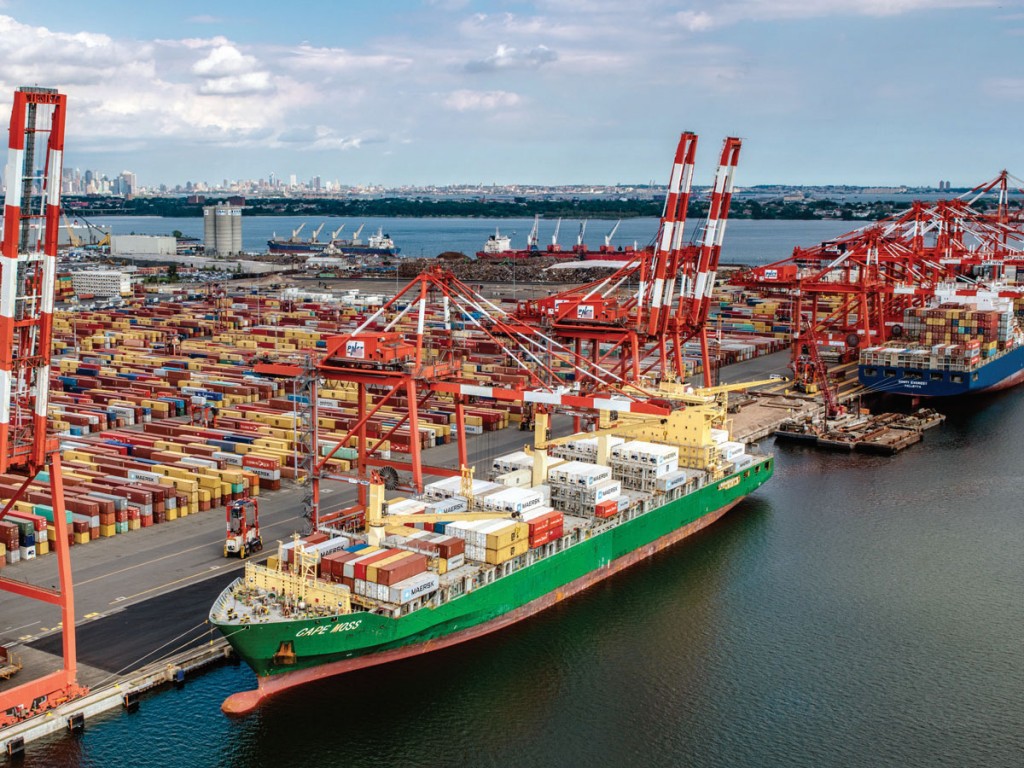
As the saying goes, whoever is No. 2 must try harder, and the New York/New Jersey port is continuing to do so, including through expanded stakeholder collaboration.
Business, Economy Strong
“Business is strong; the economy is strong.” said Rooney, a three-decade industry veteran who in April was promoted from assistant director. “All of the things that make New York/New Jersey attractive and viable are all in place and working well.
“The Chinese tariffs and the trade wars and the shifting in manufacturing certainly help in terms of our record and strong volumes,” she added. “And the fact that we, unlike other ports in the country, are able to service all corners of the world certainly helps us.”
Ruda, who became the Port of New York and New Jersey’s director in April after five months as interim director following departure of Molly Campbell to pursue a Harvard University fellowship, said he is pleased with the advance to No. 2 ranking, adding, “We’ve got to act like it.”
In the past year, New York/New Jersey, long the highest-volume boxport on East and Gulf coasts, has moved ahead of the Port of Long Beach in containerized cargo throughput, ranking behind only Southern California’s busiest containerport, the Port of Los Angeles.
Ruda, who served two years apiece as assistant director and deputy director of the New York/New Jersey port after 11 years in senior management at the Port of Portland, Oregon, said his three decades of industry experience, including his time in Portland, have prepared him for his present position.
“Adjusted for size and scale, the issues that you encounter are not dissimilar,” he said. “I would say the major difference is, when you’re here in New York and New Jersey, you are really at the intersection of global commerce. You are really relevant. You don’t have to hunt for business opportunities.
“Our challenge is basically sifting through all the opportunities that we do have and making really good strategic choices, because, ultimately, we can’t say ‘yes’ to everybody,” Ruda said.
‘Yes’ to Big Ships
Of late, the Port of New York and New Jersey has been saying “yes” to a whole lot more larger containerships. The trend times with deepening of channel areas to 50 feet, completed in 2016, and raising the navigational clearance of the Bayonne Bridge to 215 feet, completed in 2017.
Not surprisingly, Rooney sees the port continuing to set records and build upon its intermodal gateway position:
“I think the volumes speak for themselves,” she said. “The big difference that we have seen, particularly because of the channel deepening and the raising of the Bayonne Bridge, is the size difference of the vessels.”
Four years ago, she said, the majority of the port’s cargo was being carried on boxships with a capacity of between 5,000 twenty-foot-equivalent units and 6,000 TEUs. Today, according to Rooney, “the lion’s share” is being carried on ships with a capacity of 8,000 or more TEUs.
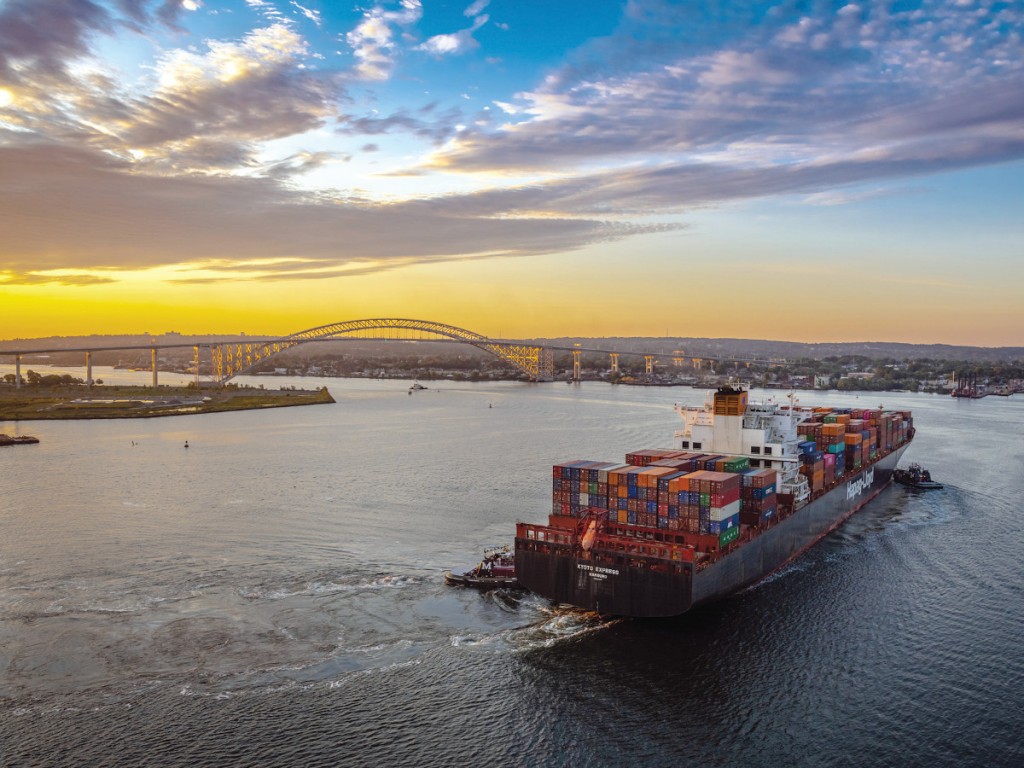
Prior to completion of the Bayonne Bridge project, ships with capacities of about 9,400 TEUs were unable to reach container terminals at Newark and Elizabeth in New Jersey and Staten Island in New York.
Through the first seven months of calendar 2019, more than 32 percent of the port’s cargo came on ships with a capacity of 9,000 TEUs or more, Rooney said. That compares with just 4.9 percent of the port’s cargo coming in on such larger vessels just four years earlier.
Part of the challenge posed by the bigger ships relates to getting all those boxes loaded and unloaded.
“We are still a truck port,” Rooney said, noting that 85 percent of the port’s volume leaves via trucks. “While we’ve been making the investment outside the gates on the common-user infrastructure, all of the investments that the terminal operators have been making inside the gates in cargo-handling equipment, new gate systems, new terminal-operating systems, extended capacity and new ship-to-shore cranes allows for them to efficiently handle the larger ships which have the larger volume of cargo being discharged.”
Billions Invested
Marine terminal operators have invested more than $2 billion in their New York and New Jersey facilities over the past 15 years, she said, with another $2 billion anticipated to be similarly spent over the coming decade.
That is in addition to the $6 billion invested by The Port Authority of New York and New Jersey in infrastructure undertakings including the channel and Bayonne Bridge endeavors. Another $1.1 billion is in the capital program for the next 10 years.
For the 15 percent of cargo moving by rail, efficiencies are being enhanced through port investments and partnerships with the two Class Is – CSX and Norfolk Southern – now directly servicing five of the port’s six container terminals via on-dock and near-dock installations. The sixth, the Red Hook Terminals facility in Brooklyn, is served via a common-user rail facility.
Moving greater volumes via rail assuredly is part of long-range plans, including those posited in the 30-year master plan, unveiled in July following more than 2 1/2 years of collaboration with stakeholders by the landlord port:
“There was actually a focus on really ratcheting up the stakeholder outreach,” Ruda said. “We cast a pretty wide net, obviously including all the typical suspects, such as existing customers, users of the port, the trucking community and other industry stakeholders, but also a lot of outreach into our host communities and even subsets within those host communities, including environmental justice communities.
“We heard a few consistent themes representing the major focus of the feedback,” Ruda said. “On a positive note, the stakeholders want the port to be successful. They want the port to grow. Communities want to have access to the jobs – not just the waterfront jobs but the jobs the industry generates in logistics, warehousing and so on. And the host communities are going to hold the port accountable for the environmental impacts.”
The plan calls for continuing operation as a landlord port, Ruda said, commenting, “Being a landlord port doesn’t give you a free pass on your share of the contributing infrastructure. We’re going to continue to be heavily engaged in waterways infrastructure, navigation infrastructure, berths and wharves, roadways and rail.
Volume May Double
“We come out of a master plan with at least putting out there that, over a 30-year timeframe, you can see a doubling or more of freight,” he said. “We actually don’t need to spend time seeing if that’s correct, if it’s going to be 2 percent or 3 percent annual growth or whatever. What it really means is the Port Authority, with its tenants, needs to plan and define – or actually redefine – volume triggers such that we stay adequately ahead of the capacity curve to meet that demand.
“You don’t just build and they come,” Ruda continued. “You have volumes and other operational triggers that really begin to inform when and where you do things. For a Port Authority that’s not given our own geography, that’s not creating huge tracts of industrial land, we’re going to have to make very prudent land use choices as we evolve and grow over time.”
Rooney pointed out that the port’s 10-year plan approved in 2017 provides a series of recommendations on how land use may be optimized in order to handle expected demand.
“There are still a number of things we need to do moving forward,” Rooney said. “For example, we would expect that, in the future, and this aligns with what the community stakeholders and environmental justice folks are looking at, we’re looking at an evolution of cargo-handling equipment and all of the industrial equipment in the port transitioning from diesel to electric technology or some alternative fuel.
“Also,” she said, “in order to create efficiencies in the terminal, we’re looking to more communications between the various types of equipment. That’s all going to require a significant investment in electric infrastructure and telecommunications infrastructure beyond what we’ve got right now.
“The port master plan lays out as an early action item doing a study of the capacity that we will need in the utility infrastructure so that we can build that and get that in place before it’s actually all needed,” she said.
Resiliency Critical
Rooney noted that resiliency is a vital aspect of future plans.
“When we talk about resiliency, it’s not just about resiliency to, God forbid, another Hurricane Sandy [which hit the Atlantic Coast in 2012], but it is resiliency to any type of disruption to the supply chain,” Rooney said. “When we talk about climate change and sea level rise, we are in the midst of a study that will help us redevelop and rebuild all of the wharf and pier infrastructure. That clearly needs to be done when we have 60- to 70-year-old infrastructure that the ships are all tying up to. That clearly needs to be done with sea level rise and resiliency in mind.”
Asked about his priorities for the port, Ruda noted that the Port Department is part of a bistate entity that also encompasses airports, bridges, tunnels and bus and rail transit.
“The priorities fall into two buckets,” he said. “One is that the Port Department doesn’t exist in a vacuum at the Port Authority. We’re part of a broader agency, and that agency has its own set of guiding principles and imperatives. Some of that goes down to how we work, with honesty and integrity. Like all public and private institutions, we have a big focus here on diversity and inclusion. You might call this the behind-the-curtain stuff that people may not see on a day-to-day basis.”
Ruda said the second metaphorical bucket holds priorities more specific to the Port Department.
“One is connecting and being far more visible with the customer and shipper community,” Ruda said. “I think we’re doing that.
“Another priority for me is that I think the port needed to renew and reinvigorate its relationship with waterfront labor, and I think that’s moving in the right direction,” he continued.
“And I think this is not singularly a port initiative, but there’s much more of a premium today at the Port Authority to be executing,” Ruda said. “It’s not enough that you make phone calls. It’s not enough that you send emails.
“It’s actually delivering on projects and programs – things like growing our intermodal rail,” he said, citing recent completion of a new intermodal container facility at Bayonne. “It’s not just an aspirational goal with no metrics.
“For me, it’s like acting like, well, now we’re the No. 2 port in the country, and we’ve got to act like it,” Ruda said. “We’ve got to have a presence. We’ve got to be engaged with our customers.”
For example, a four-stop Ruda business trip to Europe a few weeks ago revolved around meetings with the four largest container carriers calling New York/New Jersey.
Cargo Shift Continues
“From a market standpoint, there is one surprising thing,” Ruda said. “If you asked me three years ago about the shift [of cargo routings] from the West Coast to the East Coast, I would have answered that it had sort of played itself out and was no longer an issue.
“But that’s not the case,” he said. “We’re continuing to see a shift of that intermodal cargo from the West Coast to the East Coast. I’m not suggesting that the Port of New York and New Jersey is capturing 100 percent of it, because my counterparts to the south are also seeing some of that volume, but I think that is certainly part of our growth story here.
“I attribute that to having the infrastructure, raising the bridge, but it’s big-ship economics and also Class I railroad economics,” Ruda went on to say. “There are 19 different ports you can move through to get to the Midwest, so we have to compete for that cargo.”
Records volumes would indicate success in that competitive realm. For 48 of the first 49 months of Ruda’s tenure at the Port of New York and New Jersey, the port has seen month-over-month gains in intermodal cargo throughput.
“Growing that intermodal is definitely one of our strategic imperatives,” Ruda said.
Ruda said, even though New York/New Jersey is a landlord port, Port Department leadership does not hesitate to actively engage in righting the figurative ship when necessary.
Rooney interjected that, when the Port of New York and New Jersey a half-dozen years ago embarked on its collaborative Council on Port Performance initiative, “the supply chain was falling apart in the Port of New York and New Jersey, and we had problem after problem after problem after problem.”
“And we stepped up with a way to address that,” Rooney said. “In the conversations that took place at that time, we helped all partners in the supply chain understand that we need to be rowing in the same direction. If the trucking industry has an issue or the chassis industry has an issue, it’s not unique to them. It’s got a cascading effect, with upstream and downstream implications.
“So,” she said, “there was a change in mindset a couple of years ago from this being just your own issue, as an individual business enterprise, to that this is about the larger Port of New York and New Jersey and all of the partners needing to work together for that cargo.”
All that said, when does New York/New Jersey anticipate surpassing the Port of Los Angeles in containerized cargo volume to take over the nation’s No. 1 spot?
“That’s a good aspiration,” Rooney said, “but we’ve got a ways to go.”
Through the first eight months of calendar 2019, New York/New Jersey realized volume of 4,992,146 total import and export TEUs, up 6 percent from the TEU count for the January-through-August period of 2018. New York/New Jersey’s eight-month figure of 4,992,146 puts the port ahead of the Port of Long Beach, at 4,971,407 TEUs for the period, but still well behind the Port of Los Angeles, which moved 6,311,872 TEUs over that time span.


