
With enhanced terminal infrastructure and efficiencies and construction under way to bring channel depth to 55 feet – the most among U.S. East Coast maritime gateways – The Port of Virginia clearly is putting out the welcome mat for cargo business.
John F. Reinhart, entering his seventh year as the Virginia Port Authority’s chief executive officer and executive director, told AJOT he is enthused not just by record volumes moving across Virginia docks in 2019 but, moreover, is encouraged by prospects for an even brighter future.
“We’re doing more, faster, more efficiently, safer, with the capacity to continue to grow,” said Reinhart, who, prior to taking the helm at the VPA in February 2014, served 23 years with Maersk operations, including 14 years as chief executive officer of Maersk Line Ltd. “To me, the whole deal is a tribute to the men and women who work across the board.
“The Port of Virginia is thrilled with the execution of our strategic plan by our team,” said Reinhart, who last year was inducted into the International Maritime Hall of Fame. “We have modernized and doubled the size of Virginia International Gateway. We’re 80 percent through on doubling and modernizing South NIT [Norfolk International Terminals]. And we are in the water as of Dec. 1 dredging to have the deepest, widest channels on the East Coast.
“We’re very thrilled with the way the execution is coming along, improving our service, improving our capacity and making us a safe harbor and an easier port to do business with,” he added.
Barging Burgeoning
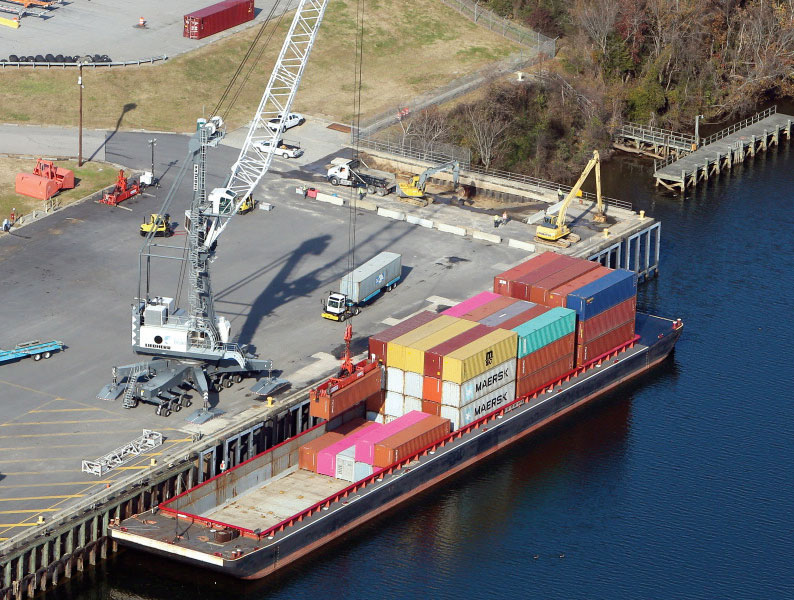
Not only are The Port of Virginia’s four terminals in the Hampton Roads area flourishing, with total container volume in calendar 2019 reaching a record 2.93 million 20-foot-equivalent units, but so, too, is barge activity along the James River.
“We’ve grown our barge program to Richmond Marine Terminal by just under 20 percent last year,” Reinhart said, “and we have a new transloading facility right there at RMT to take agricultural product and load it into containers and put them back on the barge.
“We are taking the imports up and are bringing loaded agricultural product back,” he continued. “We see that as just a wonderful use of the facility, in getting the two-way traffic, and we see that business adding double-digit growth again this year.”
Agricultural product on the barges now is mostly soybeans, with potential for also handling wheat. With the new trade agreement with China taking effect, Reinhart sees opportunity to have a lot more agricultural product – including soy, wheat, pork and poultry – being exported from Virginia to China.
“We look at that two-way traffic and that increase of the export commodities as being very accretive to our growth this year,” he said. “Obviously, we’re all watching China and the coronavirus very carefully because of what it may do to the country and manufacturing and trade for the near term and the devastation it’s creating with the Chinese people.”
In January, the RMT reefer service got a further boost with announcement of a $189,840 federal grant to be used toward buying another large portable generator and additional related equipment to be deployed on the second barge that was brought into the service in 2019, facilitating moves of refrigerated containers containing agricultural products on both barges.
Terminals Expanding
That federal grant, while important, is small change compared with the $320 million spent over the course of three years to double capacity of the Virginia International Gateway in Portsmouth. The VIG project, completed last fall, realizes full benefits of a contingent of eight super-post-Panamax ship-to-shore cranes and 56 rail-mounted gantries, or RMGs, as well as enhanced rail and gate infrastructure, at a facility accommodating container vessels with capacities of more than 14,000 TEUs – the largest boxships to call the U.S. East Coast.
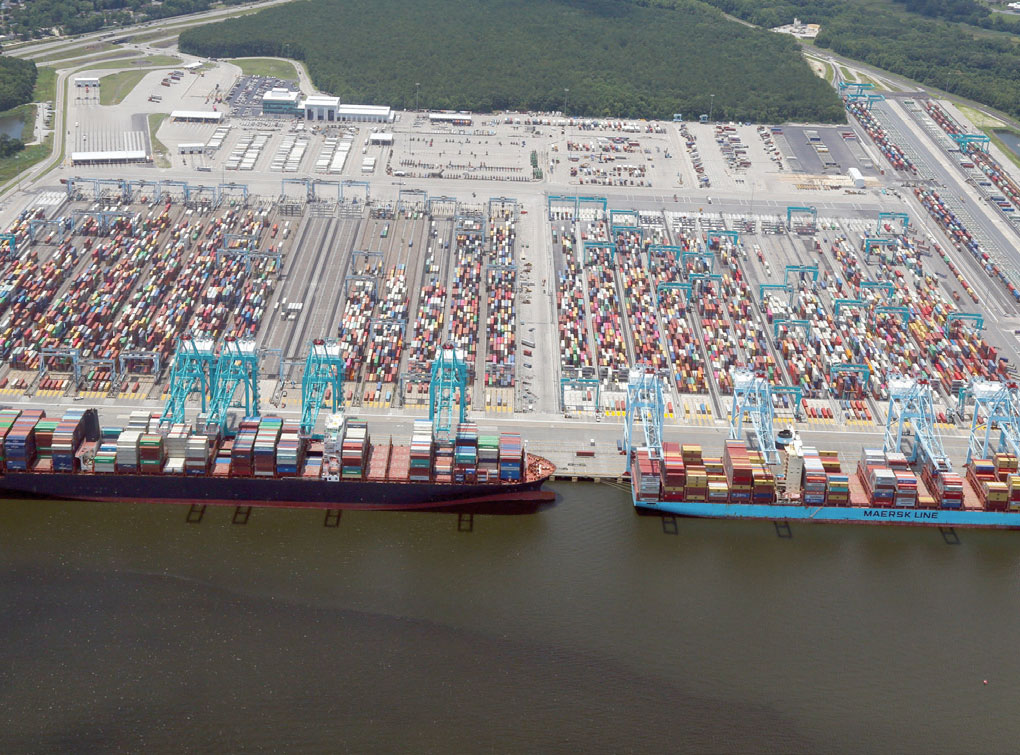
Three ultralarge container berths also are already available along 50-foot-deep water at Norfolk International Terminals, where expansion is on target for completion in fall 2020, with additional RMGs and container stacks incrementally coming online through spring and summer, to ultimately support 30 semiautomated stacks at NIT.
“We’ve got the capacity at NIT and VIG to a point where we’re operating in a very comfortable place,” Reinhart said.
“One of the things I’ve been very pleased about is that our operational efficiency has been so solid that we’ve been able to scale back our hours and still have adequate capacity for the motor carriers,” he said, noting the weekday terminal opening time has been moved to 6 a.m. from 5 a.m., plus terminals no longer are opening for a half a day on Saturdays. Two years ago, he said, terminals opened as early at 1 a.m.
“Talk about operational efficiency,” Reinhart said, also citing a shift to all-electric power from diesel. “We use less energy. We’re more resilient. We’re more sustainable.”
He said the terminals are consistently delivering 30-minute turn times for single moves by trucks.
“We really have a fluid capacity,” Reinhart said. “We’re still only utilizing about 60 percent of the slots that we have available in our reservation system, because we’ve become so efficient.”
Offshore Wind Coming
Reinhart said the VIG and NIT improvements are allowing the VPA to take more venerable facilities, namely Portsmouth and Newport News marine terminals, and market them for new business, such as offshore wind.
Negotiations began in early 2019 with Denmark-based power company Ørsted as it was the partner chosen for Dominion Energy’s first two wind turbines to be put in place 27 miles off the Virginia coast. By January of this year, a lease agreement was announced with Ørsted, initially for 2 acres at Portsmouth Marine Terminal, with options on additional 20- and 18-acre tracts, to potentially get to a total of 40 acres “that they could grow into over the next couple of years,” Reinhart said.
Ørsted alone is contracted to deliver 3,000 megawatts of annual offshore wind capacity over the next six years, and Reinhart said there is potential for use of Portsmouth facilities as a staging hub for additional offshore wind projects along the U.S. East Coast.
“We’re a deepwater port, we have no airdraft restrictions to get out to the open water – and these turbines are pretty big platforms – so we can be a really unique staging base,” Reinhart said. “Now, we’re looking at the other supplying subcontractors to see if there are other opportunities to grow the supply chain for offshore wind here in Virginia.
“That would be an industry for the future,” he continued. “It supports cleaner renewable energy, which is part of our state’s move to increase the percentage of power from renewables. It gives you a new industry that will be here for decades to come. It’s a manufacturing base, and we have a wonderful network of shipbuilders, ship repair people, people with skills to be supportive of this industry, and it helps us with our efforts related to sea-level rise as well, because we’re trying to reduce the carbon footprint.”
Channel Work Beginning
Meanwhile, the channel-deepening endeavor’s first constructible element got under way in December, to bring the existing 1,000-foot-wide channel to a depth of 56 feet at mean lower low water west of the Thimble Shoal Channel in the Chesapeake Bay. Engineering and design work is proceeding on succeeding elements, concentrating first on outer zones and then inner harbor areas, which are to go to 55-foot depth from their present 50 feet.
The $350 million channel initiative, currently funded by the state, did not get a hoped-for new start designation from the U.S. Army Corps of Engineers in February, but Reinhart remains optimistic about securing federal backing.
Even before the 2025 projected completion date for the whole channel project, a bypass area is to be finished with a 1,400-foot-wide channel, facilitating simultaneous two-way ship traffic.
“Some of the benefits should start to accrue even before the full project is complete,” he said. “We’re going to be able to handle the biggest ships in the trade.”
The larger ships, of course, mean more peak truck and rail activity, and the VPA is progressing on both those fronts.
In addition to offering swifter truck turn times, the VPA runs its own chassis pool and has been bringing in all-new chassis with state-of-industry features such as radial tires, enhanced braking systems and LED lights.
“We’re modernizing our fleet of chassis every month,” said Reinhart, pointing out that 5,000 new modern units were brought into the fleet in 2019, replacing older ones.
“Our goal is to bring our average fleet to 2012 or 2013 and younger,” Reinhart said, noting that, just two years ago, the average chassis dated back to 2002, and that has already improved to 2009. “That’s a safety effort, a speed of service effort and a reliability effort, and it also saves fuel because they’re not using the old intermodal tires; they’re using radials. We’re trying to be a responsible chassis pool and provide the most modern equipment to the motor carriers.”
On the rail side, the VIG modernization included a new intermodal yard served by two Class I railroads – Norfolk Southern and CSX – which is furnishing short dwell times for load-outs.
“Our new rail yard is operating exceptionally well.” Reinhart said. “It is just moving phenomenally well. It’s amazing to see how efficiently it’s operating.”
A new rail yard also is planned for NIT, in an area where obsolete warehouses have been razed, thus averting disruptions at NIT’s current rail yard.
‘Competitive as All Get-Out’
With these enhancements, The Port of Virginia’s economic impacts are rising.
A study by The College of William & Mary’s Raymond A. Mason School of Business, released last fall, examining 2018 figures, shows The Port of Virginia generating more than $92 billion in annual impacts throughout the commonwealth while supporting more than 397,000 jobs.

In 2019, Virginia added $4 billion in private business investments, with 45 announcements of new or expanding operations because of the port, leading Reinhart to say, “That gives us that sticky freight that will help bring volume across our docks.
“We’re real pleased with how all of the things we’ve done are coming to fruition,” he said. “That gives us the ability to compete even more aggressively.
“I’m so happy with the execution by our team, the partnership with the motor carriers, the partnership with our ILA [International Longshoremen’s Association] partners, that are making this place just competitive as all get-out,” Reinhart continued. “We’re improving on every node – rail productivity, gate productivity and vessel productivity – and reducing delays getting in and out of this port. It’s a good place to do business.
“We’re going to the market saying, ‘We’re open for business, we want your business, we want to treat your cargo well. Bring it through Virginia.’”


