
When Richard Wainio, then port director of the Port of Tampa, orchestrated the American Association of Port Authorities’ inaugural Shifting International Trade Routes Workshop, held in 2008, the big issue on the horizon was preparing for completion of Panama Canal expansion in 2014.
Wainio, a former Panama Canal executive, is now semiretired, having left the port in 2012, and is doing a little consulting and cruise ship lecturing. He scarce could have imagined the gamut of challenges facing maritime shipping today, including climate-change-related concerns such as a shortage of fresh water to maintain Panama Canal operations and a demand to greatly reduce air emissions from increasingly large vessels that put pressure on still-neglected aging port infrastructure.
Canal Facing Water Woes
Among the A-list speakers addressing the Jan. 29-30 gathering at the Tampa Marriott Water Street was Dr. Ricuarte Vásquez Morales, who took over as Panama Canal Authority administrator last September.
“The interoceanic waterway has improved world trade, transportation and connectivity by reducing times, distances and costs between production and consumption centers,” said Vásquez, who holds his doctorate in managerial economics. He noted that, of the record 252.4 million gross long tons of cargo transiting the canal in the fiscal year ended last September, 67.1 percent originated or ended up in the United States.
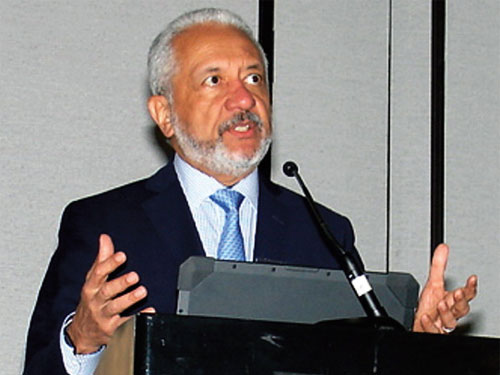
But, he said, despite the record traffic, the Panama Canal and maritime shipping as a whole face a myriad of geopolitical, economic, technological and environmental tests.
Most immediately, Vásquez said, global warming is causing rapid evaporation of lakes that feed the canal, making it difficult for there to be sufficient fresh water between locks to reliably support vessel transits.
“We need a solution, or otherwise we’re going to lose business permanently,” he said, adding that the fresh water surcharge to take effect Feb. 15 is far from a permanent answer. Various options are being explored, including possibly buying another water-source lake to augment Gatun Lake, “if the price is right,” said Vásquez, who estimated a cost of $2 billion over the next four to five years in order to ensure a sufficient water supply.
Pacts Seen Boosting Trade
In an earlier session, Kim Reed, president and chairman of the newly reauthorized Export-Import Bank of the United States, said she is encouraged by the new American trade deal with China and the U.S.-Mexico-Canada Agreement signed by President Donald Trump the day of her Jan. 29 presentation, adding she believes the pacts will result in more traffic through the Panama Canal.
“The Panama Canal is essential to our success in our country and throughout the world,” Reed said, addressing the room full of seaport leaders. “We can’t wait to put more through the Panama Canal and through your ports.”
One significant beneficiary of increased trade through the Panama Canal is Port Tampa Bay, which gains from newly introduced direct calls from Asia services feeding the dynamic Florida market, supported by burgeoning distribution center development along the nearby Interstate 4 corridor.
“The Florida market continues to see explosive growth,” said Wade Elliott, Port Tampa Bay’s vice president of business development, pointing out that Florida has passed New York as the second-most-populous state, behind only California, having more than 21 million residents, as well as hosting 125 million annual visitors.
Distribution Hubs Flourish
John Morris, executive managing director and Americas industrial and logistics leader of commercial real estate leader CBRE Group Inc., said U.S. distribution center demand continues to rise and now exceeds supply, with e-commerce a major contributor to the hot market.
Every $1 billion in e-commerce sales translates to a need for an additional 1.25 million square feet of distribution space, Morris said.

While Morris said the industry trend is toward a great number of smaller distribution centers, Jesse Kreinbrink, vice president of supply chain for Seffner, Florida-based furniture chain Rooms To Go, said his company’s DCs are getting bigger. Rooms To Go, with more than 200 stores in 14 states, is now building a seventh regional DC, this one in Nashville.
Demand to efficiently move shipments to inland destinations from megacontainerships that berth at U.S. seaports is spurring facility development for railroads as well, said Carl Warren, director of business development for the Southern Region of CSX Transportation.
CSX is accommodating that flow through its new Northwest Ohio logistics park and an increasing number of inland ports, spanning from Georgia and the Carolinas to New York, Warren said.
Box Trade Challenged
Vijay Agrawal, vice president of Americas transportation ports and waterways market for multinational infrastructure services firm AECOM, said ports of U.S. Southeast and Gulf regions are leading containerized cargo growth, with expanding inland hinterlands and regional population gains driving heightened activity.
“Inland ports are helping ports expand the hinterland and reach new markets,” Agrawal said.

Nonetheless, Agrawal said, container shipping facing numerous challenges, led by bigger ships putting pressure on ports to replace aging infrastructure with facilities better equipped to support high volumes, as well as sea-level rise and other worries associated with climate change.
In another session, William Paape, acting associate administrator of the U.S. Maritime Administration, said the federal government is offering multiple funding opportunities to support advancement of infrastructure projects in and around American ports, adding, “Deferred maintenance, as you know, is common and remains a primary concern to ports.”
Meanwhile, the roll-on/roll-off cargo sector has its own set of challenges and opportunities, according to Flavio Batista, vice president and head of North American sales for Wallenius Wilhelmsen Logistics.
The three most significant challenges impacting the ro/ro world, Batista said, are international mandates for low-sulphur ship fuels, with a goal of zero emissions by 2050; need for more ro/ro space at ports; and fragmentation of ports. Opportunities, he said, are presented by short-sea shipping between Mexico and the United States, the growing presence of start-up vehicle manufacturers; and digitalization of cars, terminals and ships.
Looking at shipping of temperature-controlled cargos, Howard Posner, president of Tampa-headquartered NAGA Logistics, said the cold supply chain is benefiting from enhanced remote monitoring and tracking capabilities but is challenged by a preference trend toward more plant-based foods, climate change, and trade wars and political instability.
Posner said the IMO 2020 low-sulphur mandate, which took effect at the start of this year, is resulting in as much as $20,000 more per day in vessel fuel costs.
Florida Leading in LNG
Casey Grigsby, vice president of programs and planning for the Florida Ports Council, and Margaret Kaigh Doyle, senior manager of marine business development for The Woodland, Texas-based Eagle LNG Partners, with liquefaction and marine terminal facilities near Jacksonville, Florida, cited Florida’s leadership in advancing use of cleaner ship fuels.
Christopher “Kit” Chope, vice president of sustainability for The Port of Virginia, said Florida’s progress sets an example for other states, commenting, “You have to start somewhere. The Florida model is absolutely compelling.”
Barry Worthington, executive director of the U.S. Energy Association, said LNG offers abundant opportunities. But he added that the world will continue to rely predominantly upon petroleum as its fuel source until at least 2050. Despite the fact that renewable sources are the fastest-growing sector of U.S. energy consumption, Worthington said, they still combine to make up only 11 percent of the nation’s present primary energy consumption.

Further, Worthington pessimistically commented, “In Washington, we refer to ourselves as Disneyland on the Potomac – and Goofy has run amok. You can choose for yourself which one is Goofy. There are plenty of characters to choose from.”
When asked by AJOT who their choice as Goofy is, both Worthington and session moderator Jim Quinn, president and chief executive officer of Canada’s Port Saint John, took the Fifth.
Labor Must Be ‘Reskilled’
In a session focused on ensuring a sufficient supply chain workforce, panelists said collaborative approaches are imperative in this era of technological revolution.
Dr. Noel Hacegaba, deputy executive director of administration and operations at the Port of Long Beach, said systems upgrades and other enhancements to technology compel ports and related entities to be sure they have workforces skilled to operate in the new environment.
“We need to think outside the box – or outside the docks, if you will,” said Hacegaba, whose doctoral degree is in public administration.
Lauren Brand, president of the National Association of Waterfront Employers and executive director of the National Maritime Safety Association, said one challenge comes in getting the most out of millennials, commenting, “I manage them not by action but by outcome.”

Brand said terminal operators in the United States this year will directly employ more than 68 million manhours on the waterfront.
Roderick Pickens, general manager of the Wallenius Wilhelmsen Solutions vehicle processing center which employs 200 International Longshoremen’s Association workers at the Port of Baltimore, said he believes it is necessary to “reskill” port workforces in these times of greater autonomous technology.
Today’s port workers, Pickens said, must be technically skilled, be leaders and decision-makers, have good interpersonal skills, be adept problem-solvers and be effective communicators.
‘Losers’ Make for ‘Winners’
In yet another panel discussion, Erik Autor, president of the National Association of Foreign-Trade Zones, said trade and tariff issues top the list of concerns being juggled by U.S. FTZs, which annually receive some $800 billion in goods. He urged closer partnerships to leverage the FTZ program to provide greater benefits.
Andy Wang, manager of operations and training for Largo, Florida-based Hit Promotional Products Inc., said trying to mitigate new U.S. foreign trade and tariff policies “has been a scramble for us,” as the firm gets most of its goods from the Asia-Pacific region, including China, India and Bangladesh.

On a positive note, Wang said the influx over the past year of direct containership calls from Asia at Port Tampa Bay has “opened up a wide range of opportunities for us.”
Another sign of hope posited by Wang is a humanitarian program, in collaboration with World Vision International, delivering “scrap” products with no U.S. retail value to needy recipients in Africa and Asia. Such products include misprinted items, as well as those imprinted with information that does not jibe with athletic contest results.
Asked by AJOT if that means kids in Africa may today be wearing “loser” Clemson 2020 College Football National Champions shirts, Wang responded, “To them, they’re ‘winner’ shirts.”


