
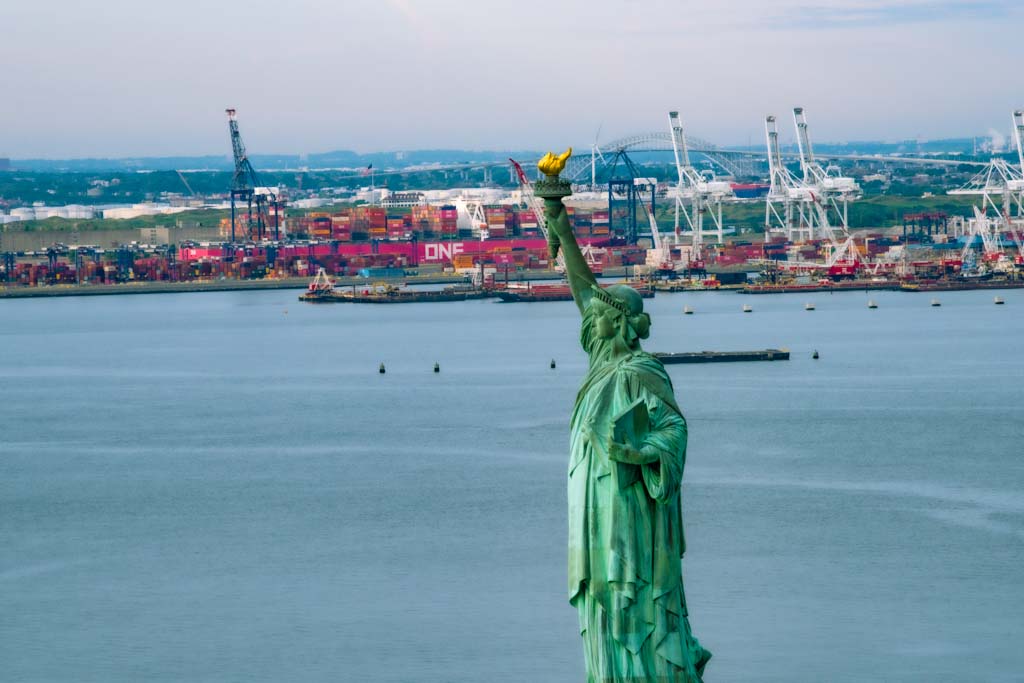
The combined Port of New York and New Jersey (PNYNJ) is the largest port on the East Coast and the third busiest in the United States. In 2024, the Port handled 8.78 million TEUs (twenty-foot equivalent units), an increase of 11% over 2023. The COVID-19 pandemic increased port volumes in 2021 and 2022 as shippers adjusted to one of the most dramatic supply chain disruptions in history.
Despite some of the challenges the ports on the U.S. East Coast faced in 2024, including a labor strike and a bridge collapse in Baltimore, the Port Authority of New York and New Jersey expects volumes to continue to grow in 2025. To handle these levels of cargo, PNYNJ is actively working to enhance efficiency in on-dock operations.
Many stakeholders are involved in global shipping, including ocean carriers, intermodal service providers, Beneficial Cargo Owners (BCOs), and several regulatory agencies.
Trucking companies are a vital part of global shipping, responsible for dropping off full containers and picking up empty containers. If both can be accomplished in one trip, or a “double move,” truckers gain efficiency while also reducing congestion on roads around port terminals, optimizing the flow of goods, and reducing emissions.
Ten years ago, “double moves” were the norm, with approximately 75% of trips involving the same location. Now, less than 30% of trucking trips are “double moves,” with carriers making extra trips. This lack of efficiency has led to a concerted effort to drive change, with groups like the Association on Bi-State Motor Carriers actively working to find solutions.
Factors that prevent truckers from operating more efficiently include requests to go to different locations to drop off and pick up containers, the lack of availability of appointments at terminals that require them, and increased congestion when only one terminal at a port is accepting appointments.
Extra Trips and Appointments are Hard to Match to Free Time
“The ideal situation for carriers is to go in and drop off an empty container and pick up full containers, moving two boxes in one trip,” said Lisa Yakomin, President of the Association of Bi-state Motor Carriers. “Instead, ocean carriers are requiring us to return empties to a different terminal because it is convenient for them.”
She explained that ocean carriers rarely provide more than one location where carriers are allowed to return their empty containers, and if that location requires an appointment to get in, it can take days to secure one.
“If we can’t get an appointment within free time, the Ocean Carrier demands that we prove the lack of capacity,” she explained. “This often requires carriers to take screenshots for every single booking attempt for every single container, which is a huge burden for truckers that causes carriers to expend an extraordinary amount of time and effort.”
The result is that carriers make twice as many moves to serve one customer, which impacts trucking company costs. In some instances, ocean carriers with no available appointments ask carriers to “hold onto the container” without any compensation for storage charges or chassis leasing fees. It is difficult for carriers to absorb these additional costs, and they are unlikely to pass these charges to their customers who question additional charges after a delivery has already been completed.
Congestion is a Result and Cause of Inefficiency for Motor Carriers Serving Ports
These factors exacerbate the issue of congestion experienced by many of the nation’s largest and busiest ports. When the Port of New York and New Jersey have only one terminal accepting carriers for drop off or pick up, traffic becomes even more congested, which adds to a lack of efficiency for motor carriers. It is not uncommon for a truck to wait so long in line to enter a port facility that the driver reaches the limit of his or her allowed hours of service (HOS) for that day.
The Association of Bi-state Motor Carriers has worked to address these issues in several ways, including communicating with ocean carriers and even speaking with state legislators to enact reforms.
One of the more promising efforts is the Council on Port Performance, where many stakeholders, including Bi-state Motor Carriers, and its Appointment System Working Group.
“Our group has met seven times since last June, and we’re currently finalizing our recommendations for how to address challenges associated with appointment systems,” said Ms. Yakomin. “We have had participation from ocean carriers, and terminal operators. Shippers and truckers, all work together to evaluate what works and what doesn’t and figure out how to resolve these chronic issues.”
Tariffs and Rules to Classify Independent Contractors are Hard to Predict
While efficiency is the top concern of the carriers her association represents, it is not the only issue to be addressed. Tariffs and labor policies are also impacting truckers that serve ports.
“The situation with tariffs is fluid and rapidly evolving, so it’s difficult to predict with any certainty what the long-term impacts will be,” said Ms. Yakomin. “The 90-day pause allowed everyone to exhale in the short term, but we are all keenly aware that the expiration date will hit right around the rush when holiday merchandise usually arrives.”
Another issue is the classification of workers as employees rather than independent operators. According to Ms. Yakomin, “Port trucking tends to attract a high percentage of owner-operator drivers because the short-haul nature of the drayage industry allows them to return home to their families every night rather than spending days or weeks doing long-haul runs.”
The National Labor Relations Board and the U.S.Department of Labor, through administrative rules and board rulings in recent years, have made it harder for employers to classify individuals as independent contractors as opposed to employees, according to Ms. Yakomin.
Some industry experts predict that the Trump Administration will reinstate its previous rules simplifying independent contractor classification standards. However, these regulations, like tariffs, are still evolving.
There is one area of common ground for most port and trucking stakeholders, and that is a recognition of the need to work together to address shared concerns. Ms. Yakomin stressed the importance of keeping lines of communication open and for all stakeholders to stay informed about the challenges and obstacles facing their colleagues.
“We’re all interdependent upon one another, and when problems arise, we must work together to resolve those issues so that we can all remain strong,” said Ms. Yakomin.


