For the American towboat & barge industry record flood in the Midwest and turbulent economic conditions make it seem like when it rains, it pours. Prospects for new business point to brighter times.
These are trying times for America’s barge industry. Record floods throughout the Midwest stopped much of the barge traffic dead in the water. And while the floodwaters have receded, “we’re nowhere near back to normal,” said Thomas Allegretti, president and CEO of American Waterways Operators, the association of the tugboat and barge industry.

At the same time, shippers are demanding more and more competitive rates from carriers, squeezing already tight margins.
Publicly traded Kirby Corp., for example, saw operating income plummet during the second quarter of this year by more than 40%, and that came before the end of the heavy rains.
Add to all this the uncertainties over the possibility of an all-out trade war between the US and China. That dispute has already severely impacted soybeans exports. Last year, soybean exports to China declined by 70% over 2017. While a shift to the European Union and Egypt certainly helped, it didn’t completely alleviate the market disruption.
Now, there’s even greater uncertainty, as shippers gear up for the fall harvests and try to anticipate demand, in light of Washington and Beijing’s on-again, off-again trade talks. “A protracted trade war would have a very negative effect on the movement of these agricultural commodities, which are such a big part of our cargo mix,” said Allegretti.
To be sure, there are a few bright spots. Most notably, a number of ports are investigating moving containers on barges. An ambitious plan to ply self-propelled barges on the Mississippi River, capable of carrying up to 2,300 containers, is winding its way from Southern Louisiana to St. Louis. These could begin service in 2022.
The Port of Charleston is also exploring barges to alleviate port congestion. In December, the South Carolina Ports Authority applied for permission for construction and dredging of a container barge operation terminal. Barges would transport containers a short distance, where they would link up with intermodal truck and rail. This could come online as well by 2022.
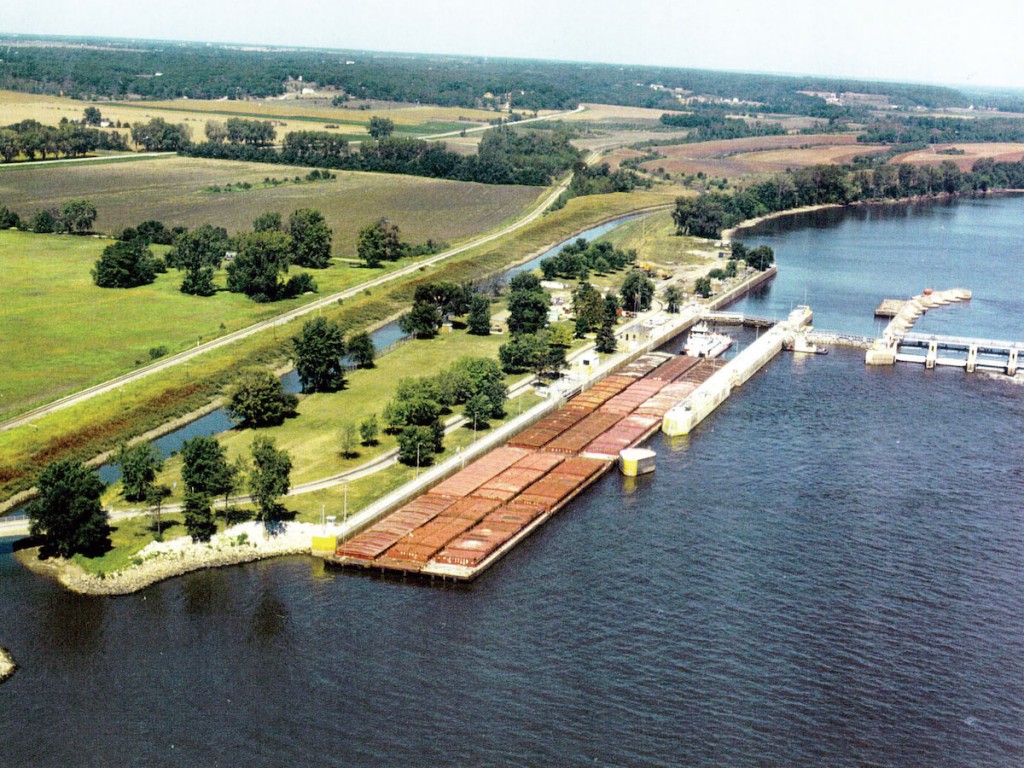
There are also indications that barge owners are investing in new equipment at an accelerated rate. Trinity Industries, which was the largest barge builder in America, spun off its barge construction operation in November, following several down years. The new company, Arcosa Marine, reports a significant uptick in new barge construction. It has reopened an idle plant in Louisiana, which is expected to soon begin delivering new barges to customers.
Operators are scrambling as well to find new types of cargo for barges to carry. Barge owner Cooper Consolidated reports that it has carried wind turbine components from Louisiana to the Upper Midwest.
Industry Consolidation
This is an industry in which fewer and fewer players are more and more dominant, understandable given the economic and financial pressures. To achieve economies of scale and the demands of shippers, bigger players are gobbling up smaller ones.
“There has been continued consolidation since the 90s and it hasn’t abated at all,” said Allegretti. He explains: “Thirty years ago, we were an industry with lots of very small companies that were family owned and that had a limited geographic footprint. They were healthy, profitable companies, but they didn’t have much scope to them,” he said.
As shippers got larger, they demanded both cheaper rates and a wider reach. They “valued the scope of a company to handle their products up and down the system as opposed to smaller pieces of the system,” said Allegretti.
America’s barge industry consists of about 5,500 tugs and 31,000 barges. Two-thirds of these ply the Mississippi River system and the Gulf Intercoastal Waterway. Most remain mom and pop operations, which means there’s plenty of room for more consolidation.
According to a recent investor presentation by Kirby, three barge companies stand out from the rest of the pack: Ingram Barge Co. and American Commercial Barge Line top the list of ownership of total dry cargo barges, while Kirby itself dominates tank barges. American River Transportation Co. is a wholly owned subsidiary of commodities giant Archer Daniels Midland. It is the third ranked dry barge operator.
Kirby, Ingram and ACBL have all grown through acquisitions. Kirby has been especially acquisitive. Its latest purchase closed in March, a $244 million deal with Cenac Marin Services, for 63 inland tank barges and 34 inland towboats. This came on the heels of two acquisitions in 2018, where Kirby spent about $500 million to acquire almost 200 barges and 75 towboats.
There’s also some horse trading going on. For example, two years back, Campbell Transportation Co., a bullish barge and shipyard operator, acquired 155 barges and four towboats from ACBL. These are barges that ply the Ohio River system. Campbell now owns more than 1,100 barges and 50 towboats.
Private Equity and Barge Industry
Where an industry is consolidating, private equity can usually be found and barges are no exception. Platinum Equity owns ACBL. Other PE firms are getting into the industry as well. In February, a consortium of private equity, led by Upper Bay Infrastructure Partners, acquired Tidewater Transportation & Terminals from another private equity firm, Stonepeak Infrastructure Partners. Tidewater, based in Vancouver, WA, has been actively buying up Pacific West Coast barge concerns.
In February as well, private equity concern Auxo Investment Partners bought a majority stake in a Great Lakes barge concern, Andrie Inc. This follows the late 2017 purchase by Auxo of a New Orleans barge company, M/G Transport Services. Auxo now has a marine “platform,” so expect other acquisitions.
Tow restrictions remain and are hampering movements along some stretches of the rivers systems. The Army Corps of Engineers and its contractors are feverishly attempting to dredge river bottoms, the result of sediment that was deposited by the floodwaters. According to Allegretti, “the Corps of Engineers and [its] contractors have been working 24/7 to try to move the shoals out of the way. And they’re being very systematic about kind of doing the worst ones first and then, but they are nowhere near done getting the river bottom back to normal.”
The barge industry tries to take some disruption in stride, Allegretti said. “The very fundamental nature of our business is that we are always subject to the challenge of nature. This year it was high water and other years it’s low water. There’s always weather and tide and currents and storms. And so, these kinds of disruptions are part of the normal cadence of our industry.”


