

Go-slow job action launched last Friday morning by some 9,000 Canada Border Service Agency (CBSA) officers with enormous implications for the smooth flow of Canada-US trade fortunately lasted well under a day after marathon bargaining sessions produced a deal with the Canadian federal government. Otherwise, the conflict would have also further complicated this Monday’s planned reopening of the border to vaccinated American travelers.
After prolonged negotiations with the Treasury Board to renew a collective agreement that expired in 2018 remain deadlocked, the Public Service Alliance of Canada (PSAC) and the Customs and Immigration Union served notice of coming strike action last Tuesday. The border would, nonetheless remain open since 90% of the CBSA agents were categorized as “essential workers” and the job action would be restricted to a work-to-rule approach.
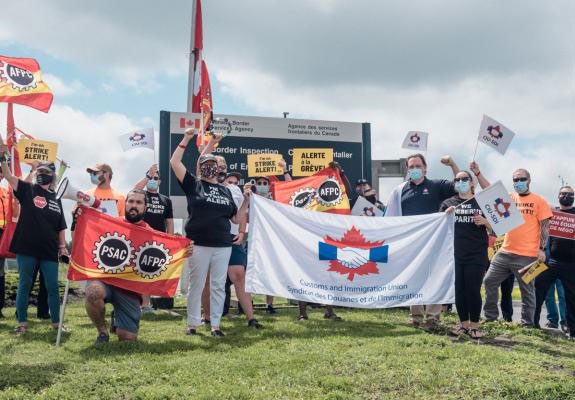
Accompanying the strike notice was a blunt warning to expect long delays at the border and a potentially “dramatic impact” on supply chains crucial to bilateral merchandise trade of $2 billion each day.
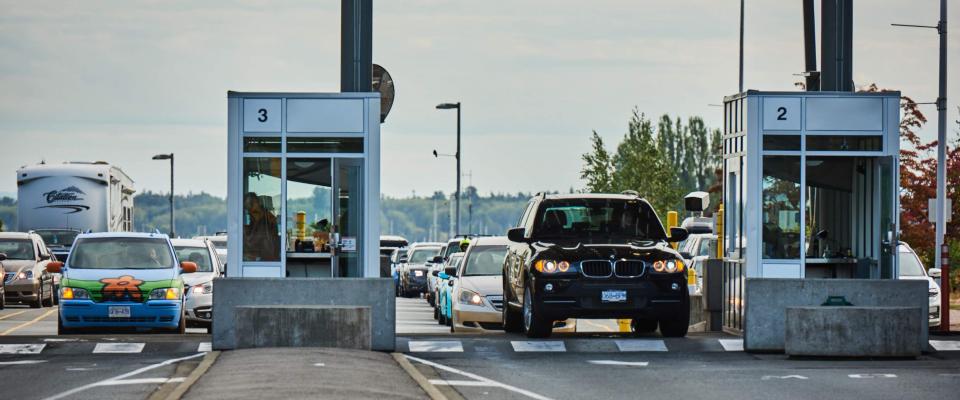
Indeed, as Friday morning and afternoon advanced, huge commercial traffic snarl-ups for truckers were building up at border crossings across the 49th Parallel. For example, commercial wait times for truckers at Windsor-Detroit’s Ambassador Bridge – the busiest land crossing between Canada and the United States – were surpassing 90 minutes.
Similar or even lengthier wait times were being experienced at such other border crossings as Blue Water Bridge in Sarnia, Ontario, the Peace Bridge between Fort Erie (Ontario) and Buffalo (NY), and Pacific Bridge in Surrey, British Columbia.
On a typical weekday, the Ambassador Bridge carries more than 10,000 commercial vehicles.
Some 5 million trucks cross the US-Canada border each year, with trucks hauling some $350 billion worth of goods in both directions.
Trucks, in effect, account for two-thirds of the surface freight on the border. For their part, rail shipments account for over $100 billion in north border freight.
While border crossings were becoming increasingly congested, business groups raised cries of alarm, urging the two sides to come to an agreement as soon as possible – as did Prime Minister Trudeau.
“We have seen the damage caused by the disruption to our rail and port systems over the past year,” noted Dennis Darby, president of the Canadian Manufacturers and Exporters. “A country-wide slowdown at the border will inflict more damage and hinder Canada’s economic recovery.”
Concurring, Corinne Pohlmann of the Canadian Federation of Independent Business evoked the adverse impact of a strike “on the movement of people and goods at a time when many businesses are already dealing with major supply chain challenges, growing labour shortages and reduced sales.”
At Canadian ports, officials said there was virtually no early evidence of negative impact on cargo flows. But industry observers opined this was likely just temporary if the conflict dragged on.
On Friday evening, when a deal (that must be ratified) was announced, Chris Aylward, national president of PSAC, said: “We are relieved that CBSA and the government finally stepped up to address the most important issues for our members to avoid a prolonged labour dispute.”
The CBSA members had been fighting for greater parity with other Canadian law enforcement agencies, and the agreement includes better protections against “excessive discipline” at work, a paid annual meal allowance of $5,000 for uniformed members and a new committee to address workplace culture as well as a committee to introduce early retirement benefits. The four-year term of the agreement also encompasses 2% retroactive annual wage increases and enhanced parental leave conditions.


