

As the clock ticks away, so do construction costs escalate in a high inflationary environment. Delays on the Contrecoeur project could mean the Port of Montreal will not have the container capacity it wants in place by 2027 to meet expected demand and thereby continue to compete effectively against key U.S. East Ports in a strong expansion mode - buttressed by the Biden Administration’s multi-billion-dollar infrastructure program. But latest developments point to important announcements this spring and summer on finalizing a financing package, followed by the selection of the terminal operator and a detailed construction schedule.
An announcement from federal Transport Minister Omar Alghabra outlining federal financial support for the Port of Montreal’s Contrecoeur container terminal project was described as “a question of weeks, not months” by Martin Imbleau, President and CEO of the Montreal Port Authority, during the port’s annual board meeting at end of April.
Federal Financing for Project
Regarding federal financing, Imbleau said that in recent discussions with Minister Alghabra “the latter confirmed to me that the expansion of the Port of Montreal at Contrecoeur remains a highly strategic project for Quebec, Ontario and Canada, and the Canadian government will be there to financially support the project. The latter assured me it will be a question of weeks, not months.
“Without these indispensable supports, we run the risk of saturation at the Port of Montreal and of supply chain vulnerability.”
Without giving details, Imbleau acknowledged that the cost of the project has risen due to inflationary pressures in the past few years. Initially estimated at between C$750 million and C$950 million, the total cost has ballooned to C$1.4 billion according to a report in The Globe and Mail which cited two sources familiar with the project’s advancement.
Thus far, the Canada Infrastructure Bank has pledged $300 million, and the Quebec government has allocated $130 million. The additional grant sought from Ottawa is reported to be several hundred million dollars. The remainder of the financing is to flow from private industry and the port which has earmarked overall capital expenditures totaling more than C$618 million between now and 2027.
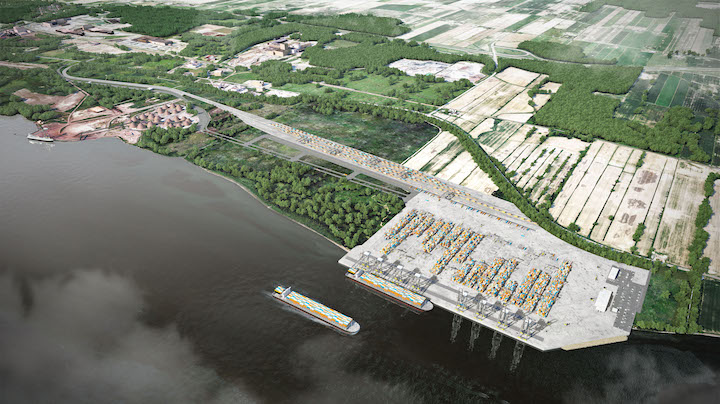
By a large margin, Contrecoeur is the most massive undertaking in the modern history of Canada’s second-biggest port after Vancouver. With space nearly exhausted on the island of Montreal and the five existing terminals approaching saturation, the decision was taken to locate the next terminal at Contrecoeur, about 25 miles downstream on the St. Lawrence River.
The project would include the construction of a 675-metre dock for two berths to accommodate vessels between 39,000 and 75,400 DWT. The project would also encompass a seven-track classification yard, a container storage and handling area, an intermodal rail yard, support facilities, rail and road accesses and a truck control area.
On the environmental front, the Port of Montreal two years ago cleared a vital federal regulatory hurdle. The Impact Assessment Agency of Canada stated that after “a thorough, science-based environmental assessment process,” it was determined that the project “is not likely to cause significant adverse environmental effects when mitigation measures are taken into account.” An issue remaining to be addressed concerns potential impacts on the copper redhorse, a protected species of fish in Quebec.
Otherwise, industry observers consider that competitive-wise the Port of Montreal is holding its own, tallying a 5.4% gain in total cargo at 34 million tons and just a slight drop in container cargo at 1.7 million TEU in 2022. Total volume also rose by 5% in Q1 2023.
Looking back, 2022 marked a major turning point in Montreal’s international trade relations, as the port’s main partner country in the container sector became India. In all, close to 1.6 million tons of containerized cargo to and from the country were handled at the port.
Over the past 10 years, the Port of Montreal has greatly diversified its markets. Today, cargo handled comes not only from Northern Europe, but also from the Mediterranean, Asia, the Middle East, Africa, and Latin America. Germany remains the main partner in Northern Europe and the second largest overall for the year 2022.
However, industry groups such as the Ontario Chamber of Commerce have urged the federal government to act swiftly – urging that any delays in the port’s container expansion could have adverse effects on industrial projects and integration with already-strained international supply chains. Robin Guy, vice-president, and deputy leader of government relations for the Canadian Chamber of Commerce have warned: “If we can’t move goods efficiently and reliably through Canadian ports, Canadian business will have no choice but to reply on ports in the United States.”
Three Bidders in Contention
Meanwhile, the three qualifying bid respondents for the Contrecoeur project unveiled in May 2022 by the Montreal Port Authority are Axium Infrastructure Canada and Pomerleau Capital, Terminal Investment Limited and Ports America Holdings, with the announcement of the winning partner originally slated for Q2 2023.
Axium Infrastructure Canada is an independent portfolio management enterprise dedicated to generating long-term investment returns from core infrastructure assets. It has more than C$1.2 billion in assets under management, including Montreal Gateway Terminals, biggest container operator at the Port of Montreal acquired in 2015 from Morgan Stanley Infrastructure Partners. Pomerleau Capital, subsidiary of a leading Canadian construction firm, invests, develops, and manages infrastructure assets in Canada and the United States.
Terminal Investment Limited (TIL) is owned by the Aponte family which also owns Mediterranean Shipping Company. TIL has a network of 70 container terminals in 31 countries. It is a co-owner, along with Logistec Stevedoring and Cerescorp of Termont Montreal with two container facilities (Viau and Maisonneuve terminals).
A leading U.S. marine terminal operator and stevedore company built on public-private partnerships, Ports America operates in over 70 locations and 33 ports. Strategic markets include Los Angeles, New York/New Jersey, Baltimore, Miami, Tampa, New Orleans, Tacoma, and Houston. Entering Montreal would represent its first direct bridgehead in the Canadian market. Worthy of note: in September 2021, Canada Pension Plan Investment Board became the 100% owner of Ports America in a deal valued at US$4 billion.


