SPOTLIGHT OF THE WEEK
Vintage Tonnage Captures the Freight Premium
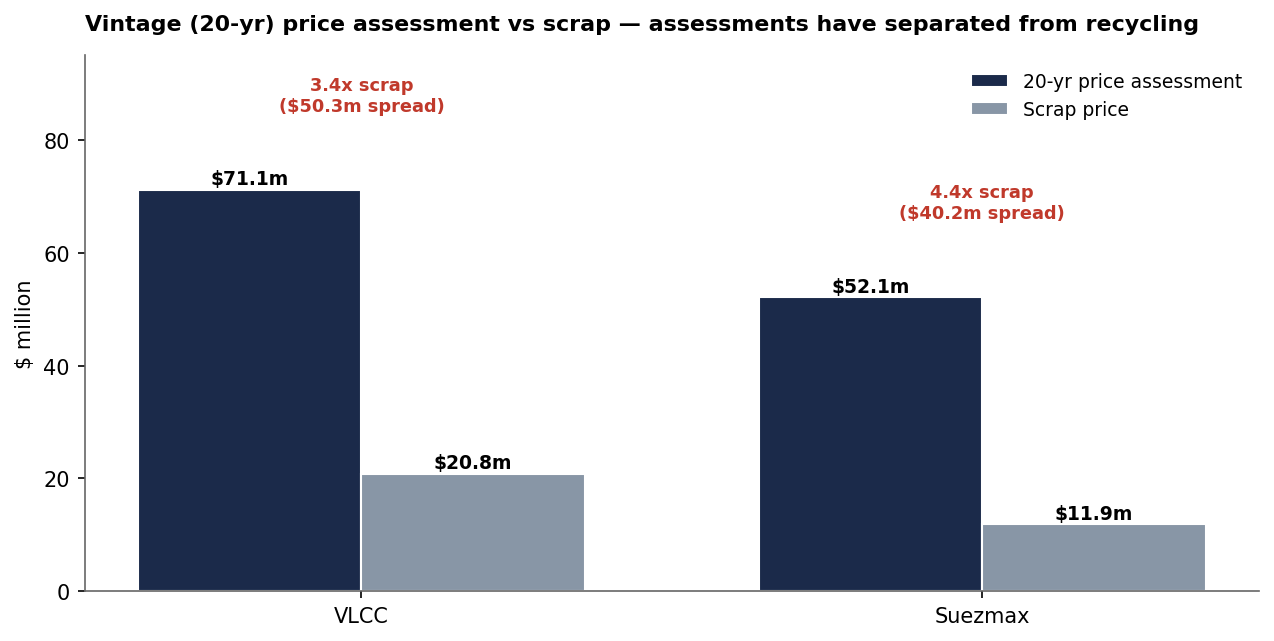
The defining feature of the current asset market is not limited to five-year-old tonnage trading above newbuilding prices. Repricing spans the entire age curve and intensifies with vessel age. VLCC values are up 30% year-over-year at five years, 42% at ten years, 61% at fifteen years, and 90% at twenty years. The Suezmax curve shows the same progression, with gains of 37%, 43%, 64%, and 78%, respectively. A 20-year-old VLCC is now assessed at $71.1m, and an equivalent Suezmax at $52.1m, despite both being much closer to the end of their conventional trading lives.

MARKET SIGNAL: Five-year-old VLCC and Suezmax values exceed newbuilding benchmarks, but appreciation increases with age and peaks at 90% and 78%, respectively, for 20-year-old tonnage.
Asset Repricing Extends to the End of the Age Curve

Hormuz Freight Watch - Military Escalation Replaces Diplomacy
UPDATED POSITION: The Iran–US relationship is not moving towards a managed reopening. The Strait has instead become a contest over who sets and enforces the conditions of passage, combining attacks on commercial vessels, military strikes, competing navigation rules, blacklisting and sanctions exposure. The latest exchange has moved the risk beyond disruption around the waterway: commercial tankers are now being used directly in the military contest between Washington and Tehran.
31 August - Projectiles near Khasab struck the Saudi-flagged VLCC Sidr and Liberian-flagged VLCC Senegal Prosperity. Bahri subsequently confirmed that two Filipino seafarers aboard Sidr were killed. Saudi Arabia attributed the attack on Sidr to Iran. Public reporting has been less definitive on responsibility for the strike on Senegal Prosperity.
1 September - US forces struck around 100 Iranian targets, including IRGC air-defence sites, radar and communications facilities, maritime assets and mine-laying capabilities. The operation also included strikes on two Iranian government tankers, the first publicly reported US attacks on Iranian tankers in retaliation for attacks on commercial shipping. Iran subsequently launched attacks against US-linked positions and assets in the region.
2 September - Iran added 11 vessels to its non-compliance list, taking the total to 56. Tehran also warned that vessels cooperating with listed ships through ship-to-ship transfers or transshipment could themselves face restrictions, detention or confiscation.
5–6 September - The tanker confrontation escalated further. CENTCOM said US forces struck three Iranian crude tankers after the IRGC targeted two US warships. Iran then claimed attacks on three US-linked vessels using what it described as an unauthorised route through the Strait. Not all Iranian claims were independently confirmed. Tehran also announced plans for a new restricted or exclusion zone outside the Strait, extending the contest over navigation conditions deeper into the Gulf.
STRAIT STATUS (late August, UKMTO): The IMO traffic-separation arrangements remain suspended, and the recognised routing system has not returned to normal operation. The latest available UKMTO assessment continues to classify the Strait of Hormuz at severe risk, with substantial risk across the Gulf of Oman. By 6 September, UKMTO had recorded 27 projectile-strike incidents around the Strait since 6 July, causing damage to commercial vessels.
CENTCOM continues to state that recognised lanes have been cleared of Iranian mines, but clearance has not produced a commercially normal passage regime. The physical mine threat is now only one part of the risk: vessels must also consider projectile attacks, Iranian routing restrictions, US naval operations, blacklist exposure and the possibility of becoming involved in retaliatory action.
War-risk cover has not reset alongside mine clearance. Recent market estimates place additional premiums at approximately 7.5–10% of hull value for higher-risk voyages, although quotations vary substantially by vessel profile, ownership, route and timing. This compares with approximately 0.25% before the conflict. TotalEnergies has estimated that sending a two-million-barrel VLCC through Hormuz and back costs around $20 million, equivalent to roughly $10 per barrel. For refined products carried on smaller vessels, the additional transport burden can approach $50 per barrel, potentially making the voyage commercially unviable.
Iran’s blacklist has moved from a regulatory threat to a practical chartering constraint. At least three Indian refiners and one major international energy company have indicated that they will avoid listed vessels, including in ship-to-ship operations. This narrows the commercially acceptable pool and increasingly separates sanctions-compliant tonnage from vessels exposed to Iranian detention, confiscation or restrictions.
Freight - East-of-Suez Earnings Retain a Wide Premium
East of Suez, VLCC time-charter-equivalents out of the Middle East Gulf are running near $702,000/day on MEG–Singapore (TD2), more than 900% above a year earlier. West-of-Suez VLCC routes sit lower but have firmed, around $219,000/day on West Africa–China (TD15) and $208,000/day on US Gulf–China (TD22), both up more than 20% on the week. In the Suezmax market, MEG–Med (TD23) holds near $335,000/day against Black Sea–Med (TD6) at $188,000/day and West Africa–Continent (TD20) and Guyana–ARA (TD27) around $112–115,000/day. East-of-Suez earnings remain roughly three times their western equivalents.


