
On Canada’s East Coast, the total container market is relatively small at approximately 2.3 million TEUs, with the deep inland Port of Montreal holding the lion’s share at 1.7 million containers handled in 2018. But with the expansion of the Panama Canal spurring traffic between Asia and North America’s eastern seaboard and more Asian trade shifting from the Pacific to the Atlantic, Canadian ports are jockeying for position to retain or grow their business domestically and in such strategic markets as the US Midwest – a daunting challenge in light of US ports like New York/New Jersey now targeting mega containerships in the 18,000 TEU category.
“We certainly live in interesting times,” exclaimed noted Canadian transportation consultant Brian Slack.
“There are some major players dipping their toes in the container market, from Hutchison Port Holdings in the Laurentia project at the Port of Quebec, SSA Marine in Melford (Nova Scotia), Avaio Capital in Novaporte (Nova Scotia), Canada Infrastructure Bank in Montreal’s Contrecoeur sector, DP World in Saint John, and PSA International of Singapore’s acquisition this past August of Halterm Container Terminal in Halifax. Only in the latter cases are there any major deep-sea container carriers presently committed to serve these terminals.
“If all projects were ever realized and succeeded in establishing regular services it would greatly exceed the capacity of the market,” Slack opined, adding: “Indeed, the first one to entice a container carrier to choose it in all likelihood would greatly reduce the chance of success of all others.”
According to Slack, the fundamental issue is which project can best demonstrate its ability to fill the ships of a potential container carrier?
“But the issue is also one that involves politics, because, with the possible exception of Melford, all projects will require public investments as well as private capital. The recent decision of the Canada Infrastructure Bank to work with the port of Montreal is an indication of how public monies will become a big factor.
“The underlying basis of this conflict between different projects is whether those that base their attractiveness on their ability to serve the ever- larger container ships, or those with best access to markets.
“Were any of the greenfield terminals to succeed, there would be serious impacts on the two existing major container ports, Montreal and Halifax,” Slack affirmed.
Montreal’s Contrecoeur Terminal
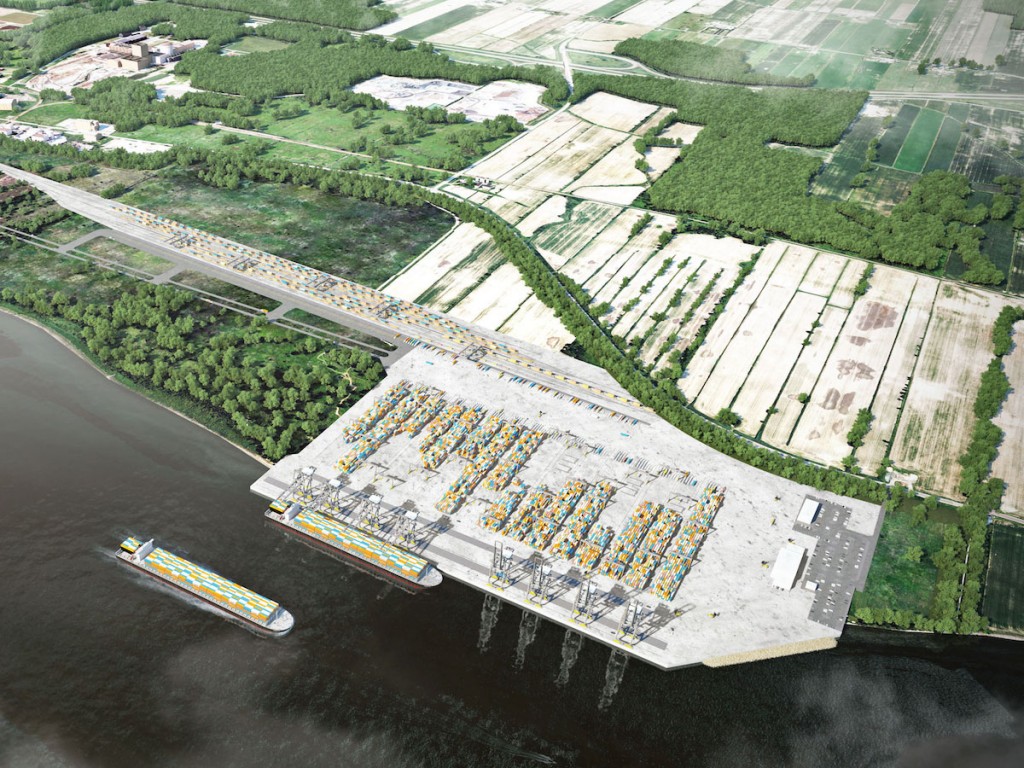
With container volumes rising in recent years and potential capacity problems on the horizon, the Port of Montreal is counting on a planned new terminal at Contrecoeur, 25 miles downstream on the south shore of the St. Lawrence River, to meet future demands. It would represent the sixth container facility at Canada’s leading East Coast port. The Canada Infrastructure Bank (CIB) recently announced it will work with the Montreal Port Authority (MPA) to advance the development of a new box facility at Contrecoeur that would boost the port’s capacity from 2.1 million TEUs to 3.5 million TEUs. It would represent the CIB’s first participation in the trade and transportation sector.
Due to draft limitations on the St. Lawrence River on the channels leading to Montreal, what is termed the Montreal Model is built on handling vessels with capacities of up to 6,000 TEUs rather than the Ultra Large Containerships. “What is striking about Montreal is the full discharge and load,” Slack recalled.
The container project is valued at C$750 million (US$ 570 million). The terminal would have a maximum annual capacity of 1.15 million TEUs upon hoped-for completion in 2023.
A Memorandum of Understanding indicated that CIB and MPA will work on the financial structuring of the proposed terminal. Due diligence will include planning and pre-procurement activities for the design, the construction, the financing, the operation and the maintenance of the terminal. CIB’s work could lead to an investment – not yet guaranteed - in the venture.
Sylvie Vachon, President and CEO of the Montreal Port Authority feels that the proposed terminal’s case is bolstered by the fact that it is not located in an urban area and is well connected to rail and highway networks.
With cargo growth rates forecast in the high single digits this year and with all sectors exceeding expectations since 2017, Tony Boemi VP growth and development, says expanding capacity through the proposed Contrecoeur terminal “is reaching critical status.”
The addition of a new service with the Mediterranean and two new carriers (Hamburg Sud and Cosco) has fueled this growth.
The port’s two major terminal operators, Montreal Gateway Terminals Partnership and Termont Montreal (part of the Logistec group), are expected to become involved either jointly or separately in the Contrecoeur undertaking.
On the important regulatory environmental front, the Port of Montreal answered this past spring a first round of questions from the Canadian Environmental Assessment Agency.
“We are waiting for a second round of questions and complementary requests and we will strive this fall to reply as quickly as possible,” port spokesperson Mélanie Nadeau told AJOT.
Halifax expansions
At the deepwater Port of Halifax, second largest container gateway on Canada’s East Coast after Montreal with box throughput of some 550,000 TEUs, the comeback trail was demonstrated by the acquisition of Halterm from Macquarie Infrastructure Partners by PSA International.
A provisional expansion of its existing berth to 2,890 feet will allow Halterm to handle two 10,000-TEU vessels simultaneously by 2020. A planned second expansion phase is to increase capacity on a more permanent basis.
This will be high on the radar screen for Captain Allan Gray, general manager of operations at Australia’s Port of Freemantle who as of November will take over the helm of the Port of Halifax from longtime CEO Karen Oldfield.
Quebec Laurentia Project
At the deepwater Port of Québec, major developments are in the works. Investment in infrastructure will reach a record high in 2019, with various projects valued at about C$70 million. And combined with planned investments by port users on their own facilities, total expenditures will surpass $169 million.
Of major significance is the port’s signing this past spring of a long-term commercial agreement with global terminal operator Hutchison Ports and Canadian National Railway to build a new $778 million container terminal re-baptized project Laurentia.
Hutchison eyes the terminal as its “gateway to the East Coast of North America,” commented Eric Ip, Group Managing Director of Hutchison Ports. Once the current review process with the Canadian Environmental Assessment Agency is completed, the Port of Quebec plans to begin construction of a 500,000 TEU initial capacity terminal by 2020 that would be operational by 2024-2025. This would mark the return of the Port of Québec to a cargo sector it lost in the 1980s after CP Ships, later acquired by Hapag Lloyd, routed its North Atlantic container service to Montreal. Today, Quebec handles some 27 million metric tons of bulk and breakbulk cargo. Mario Girard, QPA President and CEO, has made his prime objective clear: “allowing the St. Lawrence to gain additional growth and competitiveness with US ports” on the East Coast that have expanded capacities to accommodate the new generation of large container vessels.
Greenfield Challengers in Nova Scotia
Meanwhile, two greenfield projects in Nova Scotia to accommodate the largest vessels have been fighting headwinds for a number of years, but have lately shown signs of some progress despite still lacking major carrier commitment. The projects at Melford and Sydney offer deeper water, no air draft restrictions, substantial terminal footprints, congestion-free cargo handling, and closest North American port on the Great Circle Route to Europe and Asia via the Suez Canal.

First proposed in 2005, the Melford International Terminal in the Strait of Canso with a three-berth terminal and an on-dock intermodal yard will cost an estimated C$450 million to build. A new partnership to develop the terminal was formed in 2016 with SSA Marine, a big global terminal operator, and with Cyprus Capital Partners. Proponents assert that its location and over 60 feet of draft would reduce delivery times to Canadian and US markets by two to six days, comparing such a performance to Prince Rupert on the West Coast.

“Recently, we completed a detailed engineering review and cleared the site to be shovel-ready,” Mike Uberoi, CEO of Melford Atlantic Gateway, told AJOT. “The start of construction is contingent on de-risking the project, including a carrier commitment.”
For its part, Sydney Harbour Investment Partners (SHIP) is aiming to establish a C$440 million container terminal capable of handling ships more than 18,000 TEUs. The 500-acre Novaporte Mega-Terminal Project was first announced in 2012, coinciding with dredging the channel to 55 feet from 38 feet.
In the most recent development, New York-based AVAIO Capital agreed in May of this year to form a joint venture with SHIP. It has pledged to provide financial and operational support. AVAIO has invested billions of dollars in infrastructure projects across the water, transportation, digital and energy sectors, notably in North America and Europe.


