While honoring its illustrious 75-year history, the Georgia Ports Authority is strategically pursuing a still-brighter future as leadership partners with industry in building upon the often-imitated “Savannah model” for developing dynamic cargo flows.
Whereas Savannah and Brunswick, Georgia’s deepwater ports, had a long history of global trade even before the authority’s creation, the GPA was established by the state in 1945, during the economic flourish initiated as World War II was drawing to a close.
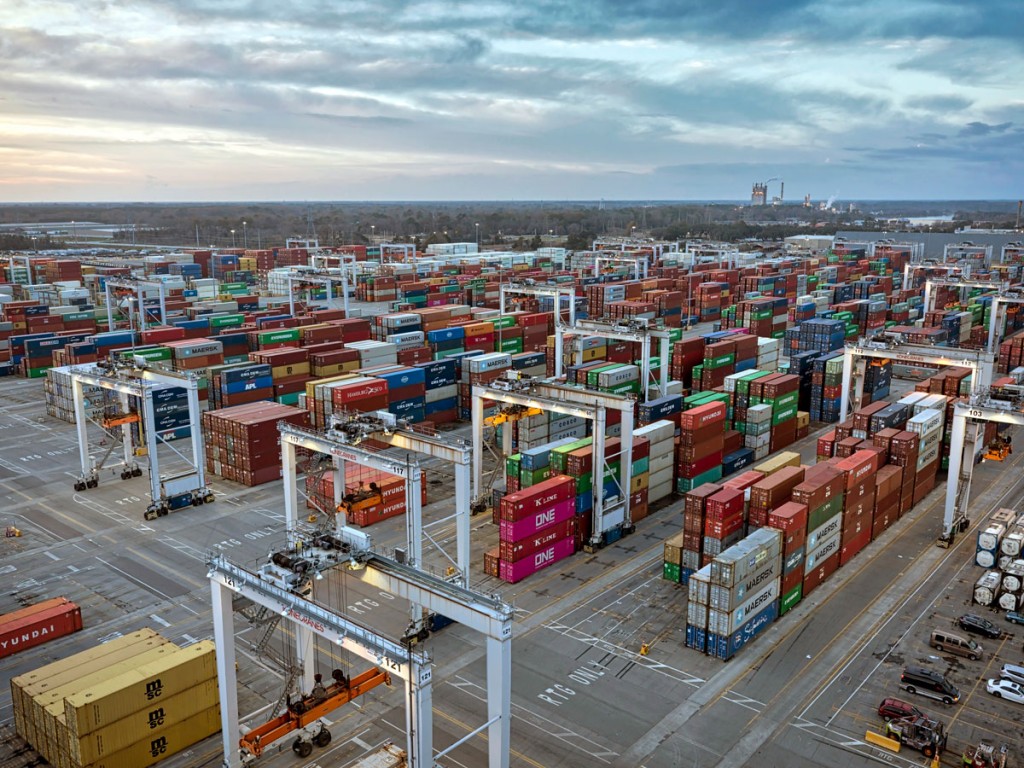
Savannah is now the third-busiest container gateway in the United States, moving more than 4.5 million TEUs per year, and port leaders say expansion plans will continue to encourage and accommodate economic growth for decades into the future.
Similarly, the Port of Brunswick is poised to grow to handle additional imports and exports of vehicles and heavy equipment. GPA’s Brunswick facilities include Mayor’s Point (1959), Colonel’s Island (1962) and East River (1982).
During the fiscal year ended June 30, 2019, nearly 614,000 vehicles moved through the three berths of Colonel’s Island Terminal at the Port of Brunswick. GPA has permits to build a fourth berth to support expansion onto more than 400 acres on the south side of the island that are already permitted for development.
The former bulk cargo facility on Colonel’s Island has been replaced with 61 acres for additional parking of vehicles and other roll-on/roll-off cargos. Also on Colonel’s Island, 55 acres have been designated for a future rail yard with parking slots for vehicles. The design has been completed to include the capacity to handle unit trains.
‘Savannah Model’ Pioneered
Since 1945, the vision of the Georgia Ports Authority’s forward-thinking board members and state leaders has allowed the authority to anticipate and take advantage of emerging trends in the maritime logistics industry.
From its formation as a statewide authority coordinating the efforts of Georgia’s ports, to its entry into container trade nearly four decades ago, to more recent handling of megavessels, the GPA has been a model of efficiency.
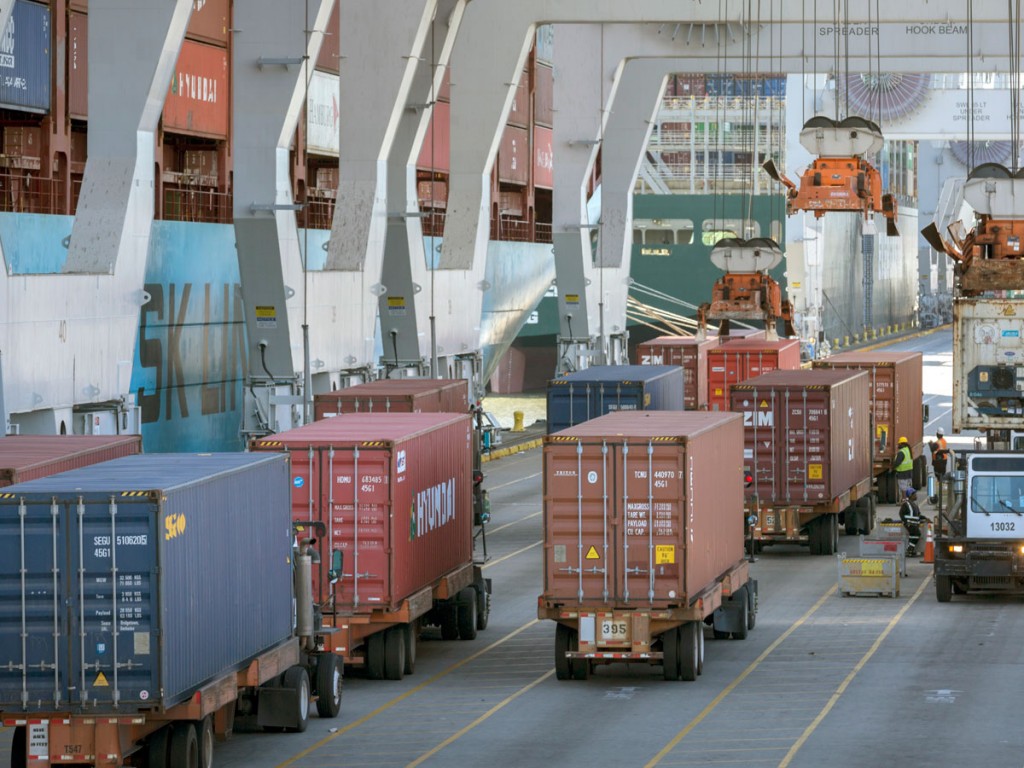
Developed to oversee terminals and foster commerce, the GPA has had a revolutionary effect on Georgia’s economy and how port services are marketed across the nation.
Starting in 1995, the GPA pioneered the “Savannah model” of marketing its services directly to cargo owners, instead of only to shipping lines. By convincing big-box retailers to establish distribution centers in Georgia, the GPA ensured not only new import business but, moreover, a steady stream of empty containers to support Peach State exports.
This marketing model, emulated throughout the nation, has proven incredibly successful in helping the GPA accomplish its central mission of spurring economic development for the state of Georgia.
The Georgia Ports Authority cooperates daily with state and local economic development authorities in their work to win manufacturing and logistics projects for the state. The authority also conducts international outreach to current and potential customers to bring more business to Georgia.
These efforts have seen enormous success. In the fiscal year ended June 30, 2019, alone, port customers announced 68 new development projects in Georgia, bringing 12,000 more jobs and $5 billion in additional investments to the state.
According to the University of Georgia’s Terry College of Business, port activity in Georgia supports nearly 440,000 private industry jobs across the state, $25 billion in paychecks each year, $44 billion in state gross domestic product and $106 billion in annual sales.
Innovations Advance
As an early adopter of containerized trade, the Port of Savannah has evolved from paper records to computer tracking as volumes have reached millions of containers moved each year.
The port’s ship-to-shore cranes have grown progressively larger to work vessels that have gone from carrying fewer than 1,400 twenty-foot-equivalent container units to today’s behemoths with capacities of as many as 14,000 TEUs.
Truck gates have expanded in number, with pre-registration and gate technologies speeding the flow of interchanges.
Rail capacity has increased with first one, then two, on-terminal rail facilities served by Class I railroads Norfolk Southern and CSX. The GPA is now in the midst of a major rail expansion, to link the two rail yards for a total of 34 miles of track on Garden City Terminal. This Mason Mega Rail Terminal project is designed to allow Savannah to better accommodate 10,000-foot-long unit trains, facilitating faster, more effective service into Chicago and throughout the U.S. Midwest.
Market Forces Favor Savannah
The consolidation of shipping lines into global consortia moving cargo on ever-larger vessels has been a net positive for the Port of Savannah, as it plays to the strength of the port’s Garden City Terminal.
At 1,200 acres, Garden City is the largest single-operator terminal in North America, with its contingent of 30 super-post-Panamax cranes along 9,700 contiguous feet of berth space offering superior ability to handle the influx of cargo delivered and taken on by super-post-Panamax vessels.
Garden City Terminal is served by two Class I railroads, provides immediate access to major north-south and east-west Interstate highways and is situated amidst the largest concentration of import distribution centers along the Atlantic Coast.
Since the Panama Canal opened its new, wider locks in June 2016, containerized cargo trade at the Port of Savannah has grown by 25 percent, from 3.6 million to 4.5 million TEUs per year. This is thanks in part to the preponderance of mega-containerships now bringing burgeoning cargo volumes to the U.S. East Coast via the Panama Canal.
Expansions Move Forward
In addition to a deeper harbor, the GPA’s Savannah expansion plans include improvements to Garden City Terminal, to bring capacity in the present footprint from 5.5 million TEUs to 8.5 million TEUs per year. The authority also intends to add a new container terminal on Hutchinson Island in the Savannah River, to furnish another 2.5 million TEUs of annual throughput capability.
Within the next 10 years, these projects are anticipated to double Savannah’s current annual containerized cargo capacity to 11 million TEUs per year.
At present, GPA has established one inland port for intermodal rail in Northwest Georgia, and the authority plans to build further rail hubs in strategic locations across Georgia to provide retailers and manufacturers more efficient links to the deepwater Port of Savannah.
As the most westerly major containerport on the U.S. East Coast, the Port of Savannah looks to take maximum advantage of its 36 weekly vessel calls and growing rail service to the Midwest. This stronger rail link should not only bring more business to Georgia but also provide Midwestern customers a fresh alternative at a port that does not suffer from the congestion and cargo uncertainty present at some other leading ports.


