
The intermodal transportation industry has changed significantly since the 1950s, when trucking entrepreneur Malcolm McLean created the modern intermodal shipping container. Today, the U.S. intermodal market, encompassing freight moved via multiple modes (truck, rail, ship) in containers or trailers, is a significant segment of the transportation industry.
While exact figures fluctuate, the market is estimated to be valued at around $51 billion, with a substantial number of facilities supporting this activity, according to the Intermodal Association of North America.
Forward-Thinking Approach
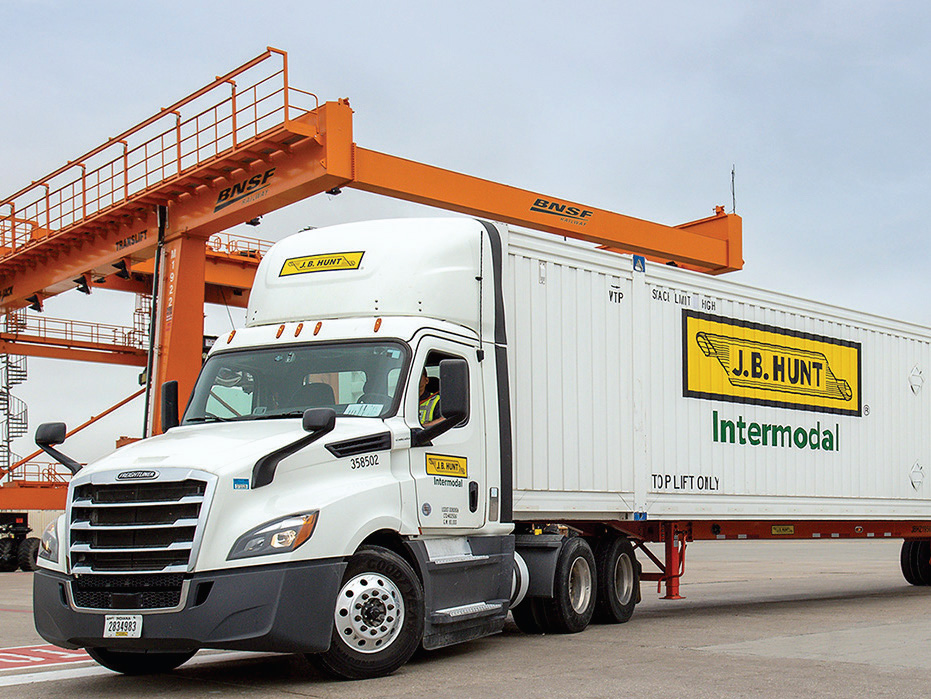
J.B. Hunt handled its first intermodal shipment 35 years ago, a move that combined the efficiency of rail with the flexibility of trucking. At the time, rail and trucking were competitors, so the idea of working together collaboratively was revolutionary.
The partnership that J.B. Hunt formed with the Santa Fe Railroad, now BNSF, was one of the first in the industry. In 1989, the two companies’ collaboration led to the creation of Quantum Intermodal Service, the first modern intermodal service.
Together, the two companies pioneered the use of double-stack containers, a crucial step that dramatically improved the capacity and efficiency of rail transportation by allowing two containers to be stacked on a single rail car.
They also established the practice of investing in and utilizing company-owned chassis, ensuring greater control over equipment availability and efficiency for their intermodal operations.
The partnership also led to the development and implementation of onsite terminals and express gates, which helped improve the speed and efficiency of intermodal operations by streamlining the transfer of freight between trucks and trains.
Efficiency and Consistency
J.B. Hunt and BNSF have continuously invested in technology and data integration to enhance their intermodal service, including platforms like J.B. Hunt 360°®. This has enabled improved tracking, real-time visibility, and better decision-making for managing shipments.
From their first technological applications to today’s cloud-based data systems connected through EDI and APIs, their innovations centered around providing a more dependable, reliable intermodal service, crucial for shippers who previously relied on over-the-road transportation for time-sensitive freight.
Quantum service has a goal of over 95% on-time performance, which makes intermodal a more attractive option for a wider range of freight. While more widely accepted as a viable means of transportation, according to Spencer Frazier, executive vice president of sales and marketing at J.B. Hunt, some shippers are still skeptical about the concept of converting truck freight to rail.
“We, along with BNSF, view the opportunity to grow by working with our existing customers to expand their intermodal business, as well as converting more shipments off the highway to intermodal,” said Frazier. “To accomplish this, the work we do collaboratively with BNSF and the railroads has to offer a high level of service, some agility, and a very consistent service product.”
Customers Have Unique Requirements and Intermodal
Both Frazier and Jon Gabriel, group vice president of consumer products at BNSF, recognize that customer service is critical to the continued growth of not only their partnership, but the whole intermodal industry.
Intermodal service is not a one-size-fits-all offering by J.B. Hunt and BNSF. “That is why the first part of our customer value delivery process is understanding the service expectations of each customer,” said Frazier.
He explained that once those requirements are identified, J.B. Hunt collaborates with BNSF to “work backward from the service level and delivery point to design a solution that meets their expectations on transit and service levels.”
The companies are also prepared for any instance when a service issue occurs or is expected.
“Anytime there is an issue, whether the domino starts with a shipment that we have, or a competitor has, it creates variability at the receiving dock, and then our customers struggle to manage the issue and so do we,” said Frazier. That is the reason that J.B. Hunt partnered with Uber and Convoy to create the Service Standards Consortium, SSC.
The primary goal of the SSC is to address challenges in freight scheduling and improve efficiency across the supply chain by defining and sharing data architecture and API standards for the exchange of scheduling information. The intent is to simplify the integration of systems across the fragmented ecosystem between shippers, carriers, and intermediaries.
Seamless Service is Critical
By its nature, intermodal or multi-modal shipments can be complex, involving multiple modes and providers to move one shipment. Gabriel said, “Our goal is to ensure the end cargo shipper does not experience that. We achieve that by providing a seamless service product.”
The processes and technology that both companies utilize, as well as the employees responsible for execution, are all designed to ensure that each shipment is handled efficiently, without a shipper ever having to intervene or become involved in the many touch points, regulatory requirements, or documentation necessary to move even one shipment.
Quantum de Mexico Latest intermodal Offering
Just months after celebrating 35 years as an intermodal provider, J.B. Hunt announced the launch of Quantum de Mexico, a collaboration that includes BNSF and GMTX, the largest rail provider in Mexico.
Like its American counterpart, the new service utilizes the latest advancements in tracking and monitoring systems, providing real-time visibility and control over shipments, minimizing delays, and optimizing performance. Designated J.B. Hunt, BNSF, and GMTX support teams provide 24/7 oversight, intended to ensure consistent and reliable transit times, including features like priority drayage as well as railcar loading and unloading.
“Quantum de Mexico represents a significant milestone in our commitment to innovation and excellence,” said Gabriel.
As more businesses use Mexico as a trading partner to solve supply chain challenges, the country has grown to be one of the Top 10 exporters in the world, with more than 2/3 of those exports destined for the US Top export industries include automotive, manufacturing, agricultural, electronics, and other service-sensitive freight.
New Opportunities
Both Frazier and Gabriel note that the state of intermodal transportation is the result of decades of collaboration, and the focus on innovation, efficiency, and service are still the foundation of the J.B. Hunt and BNSF partnership.
“We’ve invested in the technology, the capacity, the infrastructure, track, containers, drivers, chassis, and processes that can cover any industry and any type of supply chain need,” said Frazier. “I would say the opportunity for intermodal is significant and should be a key strategy for all shippers out there today that are looking for a more efficient, more sustainable, and extremely reliable way of moving their shipments.”


