
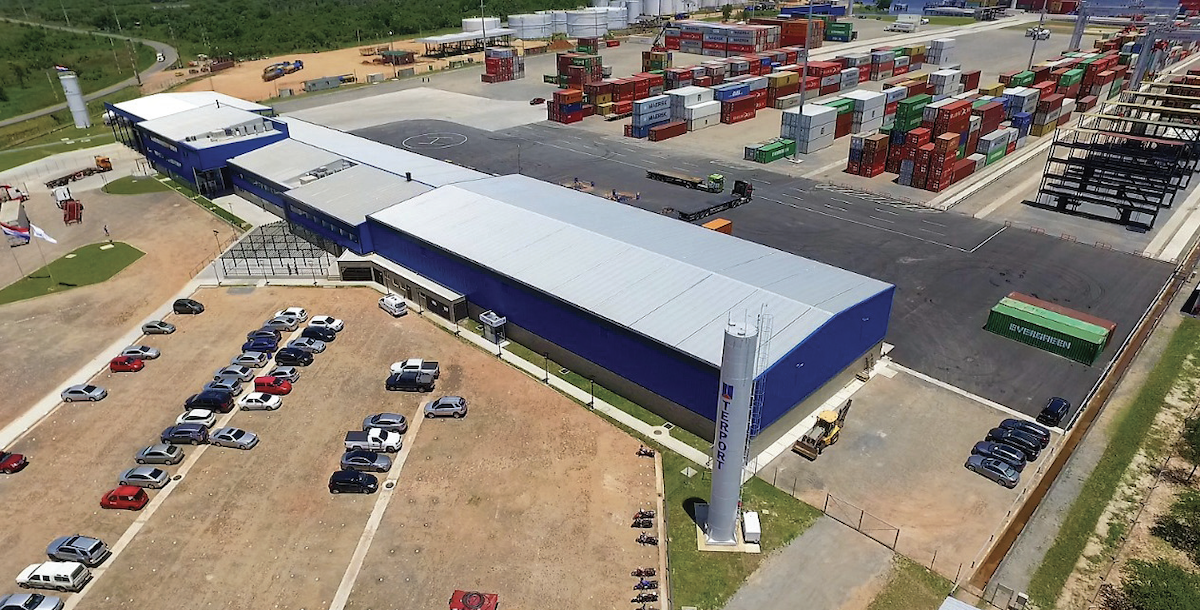
Terport Villeta, a new river container terminal, is positioned to become the transport hub of south-central South America and the main hub for international container commerce in Paraguay. The opening of the terminal in October 2018 included the installation of Navis’ N4 terminal operating system augmenting competitiveness to global standards. These new infrastructure enhancements will enable Paraguay to meet the challenges to integrate with the global economy from recent and pending trade agreements.

Terport Villeta is one of two terminals under Terport Terminales Portuarias SA. Terport Villeta developed because of the success of nearby San Antonio since 2002. Volumes grew and the Board of Directors invested in new land and planned a phased greenfield state-of-the-art terminal. “Both terminals are now operational and complement each other with all containers handled in Villeta and all general cargo Lift-on/Lift-off and Roll-on/Roll-off operating in San Antonio,” said Bernd Gunther, operations manager, Terport in a recent interview for the American Journal of Transportation.
San Antonio is on 37 acres with 394 feet of coastline on the Parana river with a draft of 32.8 feet, 4,500 container yard slots and 240 reefer plugs. The new and larger Villeta is on 50 acres with 1050 feet coastline, 8,500 twenty equivalent unit (TEU) container capacity park and 350 reefer plugs. Villeta has better draft to receive larger barges and vessels.
Paraguay’s Economy
Paraguay’s market economy enjoyed steady growth of 4% on average per year since 2014. The economy has a gross domestic product (GDP) of $39 billion and per capita GDP of $12,800. Exports were $11.73 billion mainly to Brazil, Argentina and Chile and imports were $11.35 billion from China, Brazil, Argentina and the United States of America in 2017 based on U.S. Central Intelligence Agency (CIA) reports of 2019.
Import goods to Paraguay are mostly manufactured goods such as household items, electronics, batteries, perfumes, toys and vehicles. Exports are mainly raw materials of sugar, wood, coal, wet-blue and grains explained Gunther. The European Union (EU) is Paraguay’s third trading partner after Brazil and Argentina for ten percent of Paraguay’s trade. The EU imports from Paraguay are mostly agriculture products.
After twenty years of trade talks, Brazil, Argentina, Uruguay and Paraguay agreed in June to open markets to 28 EU member states. This milestone will be the Mercosur-EU Agreement (MEUA). These four South American countries form the Southern Common Market called the Mercosur trade bloc. Paraguay is a founding member since 1991. They will benefit by exporting more beef, sugar, poultry among other farming products. However, ratification by the 28 EU members and European Parliament before implementation is uncertain. There is more assurance by the Mercosur countries’ congresses by 2021.
France and Ireland farmers have concerns from a rise in beef imports as well as environmental groups since Brazil clears land for cattle farming. The EU will benefit from access to Mercosur markets for industrial products and for agri-food products since high Mercosur tariffs will decrease on dairy products, confectionaries, wines and soft drinks. Current tariffs range from 20 percent to 35 percent by these Mercosur countries for these EU exports, according to a July 25 CNBC on-line report.
The MEUA will reduce and eliminate tariffs for more than 90 percent of products between the two blocs over the next 15 years. The two regions form markets for 780 million people valued at over $1 trillion. The Mercosur bloc is also seeking trade deals with Canada, the U.S.A., Korea, Singapore and a bloc made up of Iceland, Norway, Liechtenstein and Switzerland known as the European Free Trade Association (EFTA). Political elections in both trading blocs and Brexit could further delay ratification of these agreements.
Paraguay is in an economic recession this year, so volumes are not growing. “We expect to close the year with slightly less volume than last year so this would be approximately 60,000 TEUs. Our current operational capacity is over 100,000 TEUs without having to move to phase 2 of our macro project,” explained Gunther.
Paraguay will remain competitive in any economic scenario and further integrate its trade with global standards by modern technologies at the Terport Villeta. Terport was the first to implement Navis N4 in Paraguay in 2014 in San Antonio. Navis, of Cargotec Corporation, provides operational technologies to the shipping supply chain to optimize planning and management of containers and equipment moves in a terminal. “We now operate with Navis in both terminals with all operations planned and measured in real-time. Navis was a major investment for us and a major jump in our service quality and transparency for better communications with all parties,” concluded Gunther.
Parana River
The Parana river is mostly navigable in south-central South America running through Brazil in the north, then Paraguay and Argentina for 3,030 miles and is second to the Amazon river in all South America. Parana means “like the sea” in Tupi (Brazil) language. It passes through the capital city of Asuncion on the left bank and merges with the Paraguay river. Villeta inland port is 2.5 miles south of Asuncion. The river goes through Argentina passing Uruguay before emptying into the Atlantic Ocean at Rio de la Plata which equals the volume of water at the Mississippi River delta. Terport feeder vessels pass through Uruguay, port of Montevideo (MVD) and Argentina, port of Buenos Aires (BUE) on the Rio de la Plata estuary.
Navemar and CMP Group (Compania Maritima Paraguaya) are shareholders of Terport (50-50). Both companies operate their own feeder vessels. All shipments pass through MVD-BUE and all cargo is transported from/to Paraguay in feeder vessels. All main shipping lines operate in Paraguay and therefore Terport.
The new Villeta container terminal is a $40 million investment. “The project is in three phases which involve the gradual jump from reach stacker to rubber-tired gantry (RTG) crane operations. In the final phase, the RTG block would jump from 2 to 6 and our operational capacity would multiply by three,” said Gunther.
Gunther joined the Terport family in late 2005 as a warehouse and quay supervisor, then advanced to operations manager until 2010. He deepened his expertise by earning a master’s degree in Maritime Affairs specializing in Port Management at WMU in Malmo-Sweden for 15 months. He returned to Terport in 2011 as operations manager and is part of the Board of Directors.
“The macro plan for Terport Villeta involves a new logistics park on 370 acres in front of the container terminal. We have the project ready for execution and would accommodate approximately 20 industries,” he added. The country’s economic growth and recent trade agreements will flow with these developments at Terport.


