
Precision Scheduled Railroading (PSR) is an operating strategy, largely attributed to railroading legend the late Hunter Harrison, designed to make rail operations more efficient and thereby more profitable. But with new economic and technological challenges of the ‘20s, what’s next for railroads?
From an investors’ perspective, North American railroads have had a pretty good run over the last thirty years. After decades of being characterized as inefficient, unprofitable and slow to adapt, railroads seemingly overnight became a business-media darling. How did it happen? Well, most rail pundits would say it was attributable to three letters: PSR. Precision Scheduled Railroading or PSR was the brain child of the late Hunter Harrison – sometimes called the “train whisper” – who worked for Illinois Central (IC), Canadian National (CN), Canadian Pacific (CP) and CSX.
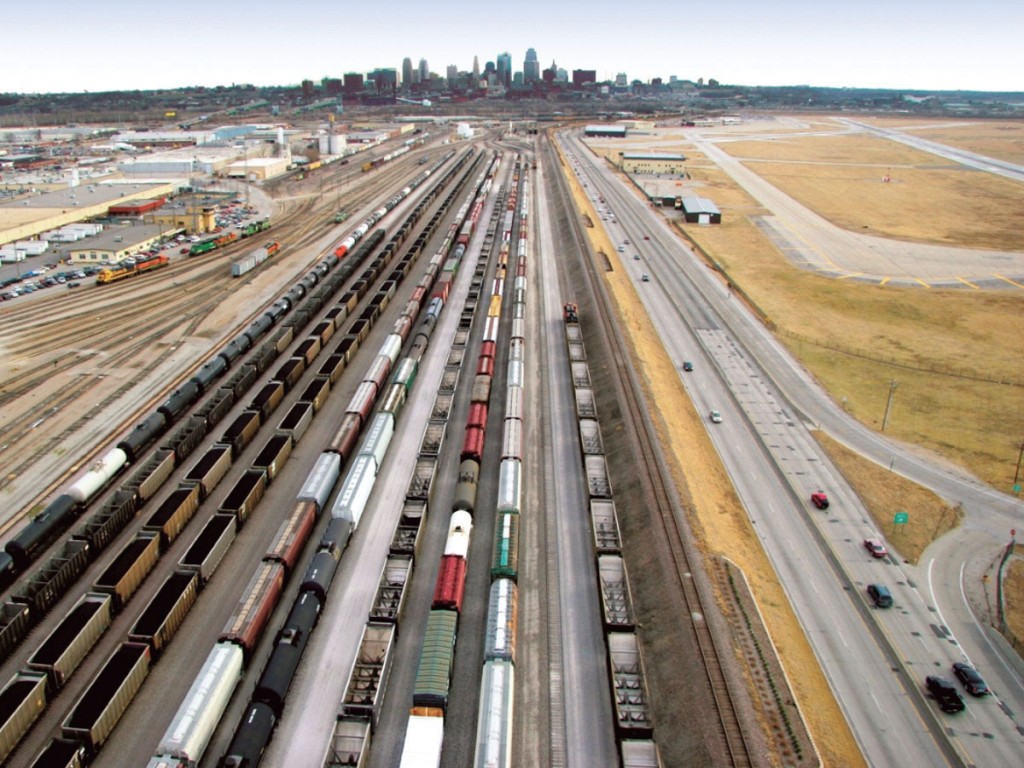
Over the course of three plus decades, the controversial Harrison developed a strategy – PSR – that not only influenced the rail companies he worked for but the entire industry. Virtually all of North America’s Class 1 railroads have adopted some version of PSR including (as would be expected) CN, CP, CSX along with Norfolk Southern (NS), Kansas City Southern (KCS), Union Pacific (UP) and to a lesser extent Burlington Northern Santa Fe (BNSF).
The idea was to cut out the inefficiencies of rail operations and to make them operate with “precision” – almost like the air integrators (FedEx, UPS and DHL).
However, with economic shifts underway, emerging technologies and new competition, will railroads have the wherewithal to adapt new strategies to remain competitive and profitable?
The ABCs of PSR
Although there are many managerial aspects to PSR the basic strategy involves: consolidating the rail networks; implementing point-to-point delivery or precision scheduling; increasing train speeds; better fuel efficiency; more efficient use of rolling stock; and staffing to the optimum level.
From Harrison’s viewpoint, the results of these measures would be a leaner more efficient network that would deliver a better operating ratio (OR) and ultimately profits and value to shareholders. [There was a recent book Railroader a biography of Harrison written by Howard Green that outlines the evolution of Harrison’s strategy in more detail.]
The ORs were the real measuring stick of success. Simply put, ORs are simply the amount of money it takes to make the “operation” go. The logic is that if $8 out of every $10 goes into operations, (as was the case with some railroads prior to PSR) there is very little margin for profit. Harrison’s idea was to drive down the ORs to 60 or under (per 100 basis points).
Part of that strategy meant cutting services and lines that were inefficient and/or unprofitable as well as reducing staffing to commensurate levels.
The result was a spinning off of tracks and services – a process often opposed by both customers and employees but applauded by investors. The upside was a far more efficient and cost effective railroad that could command higher freight rates – running against the grain of “transportation as a commodity”.
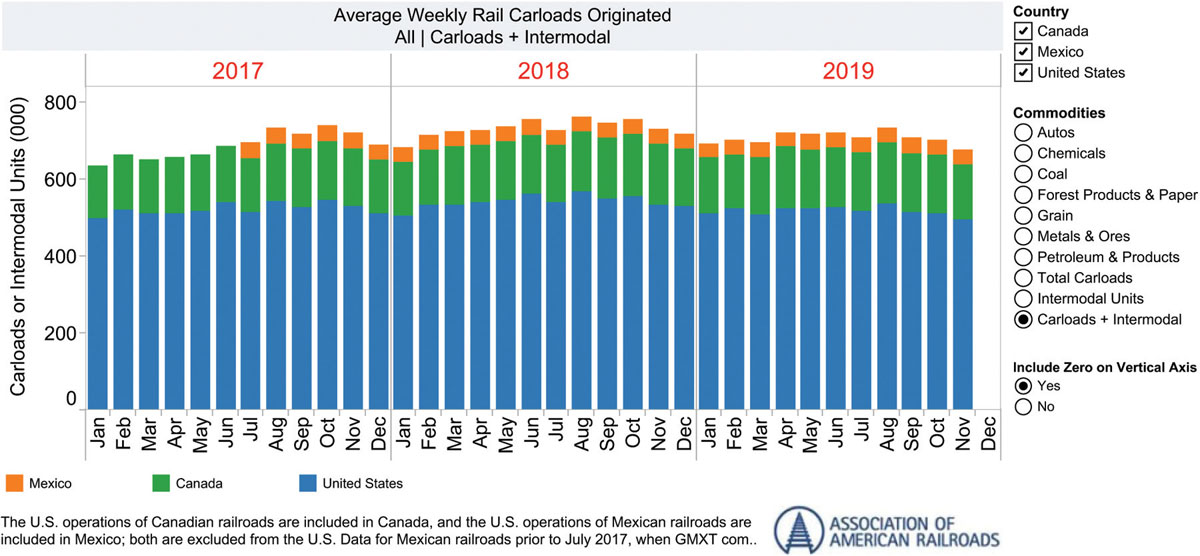
And with the implementation of PSR, the ORs for many of the railroads Class1(and others) has been around 60 and railroading has for the most part been profitable.
Kansas City Southern is a good example of how PSR can work. According to the 2019 annual report, KCS posted revenues of $2.9 billion, an increase of 6% on a 1% decline in carloads. The operating ratio was 69.1% - high by Harrison’s standards (For example, UP had an OR of 60.6 in 2019). But as KCS noted in their report, “PSR initiatives also contributed directly to operating expense savings of $58.0 million in 2019, and are projected to deliver incremental savings of $61.0 million in 2020.”
The New Landscape
In a recent report entitled Taking the Railroad Playbook Beyond PSR the authors wrote, “Railroads must cope with headwinds arising from threats to demand, evolving customer expectations (particularly for reliability and transparency), and increased competition from trucking.”
In looking at the railroad financials from 2019, it is easy to see “trouble ahead” for the railroads in the 2020s. Demand for a number of key commodities is falling and the global fallout from the novel coronavirus is exacerbating an already shaky economic situation attributable in part to the US-China trade dispute and other ongoing trade spats. And while the current Covid-19 crisis is unlikely deep into next cycle (2021), the economic underpinnings of lower demand for commodities like coal, steel & steel products, agricultural products, autos and others will impact rail fortunes in the near future.
Coal has always been the life blood of railroads. The decline in demand for coal shipments for power plants, metallurgy (steel making) and even for export markets has been a major factor in declining volumes, and to a lesser extent, revenues. According to a report by the EIA (Energy Information Agency), “The United States exports metallurgical coal and steam coal, and exports of both decreased in 2019. U.S. steam coal exports were affected by the downturn in global coal demand, dropping 30% in 2019 from 2018. Metallurgical coal had a more moderate decline of 12%.” [see charts]
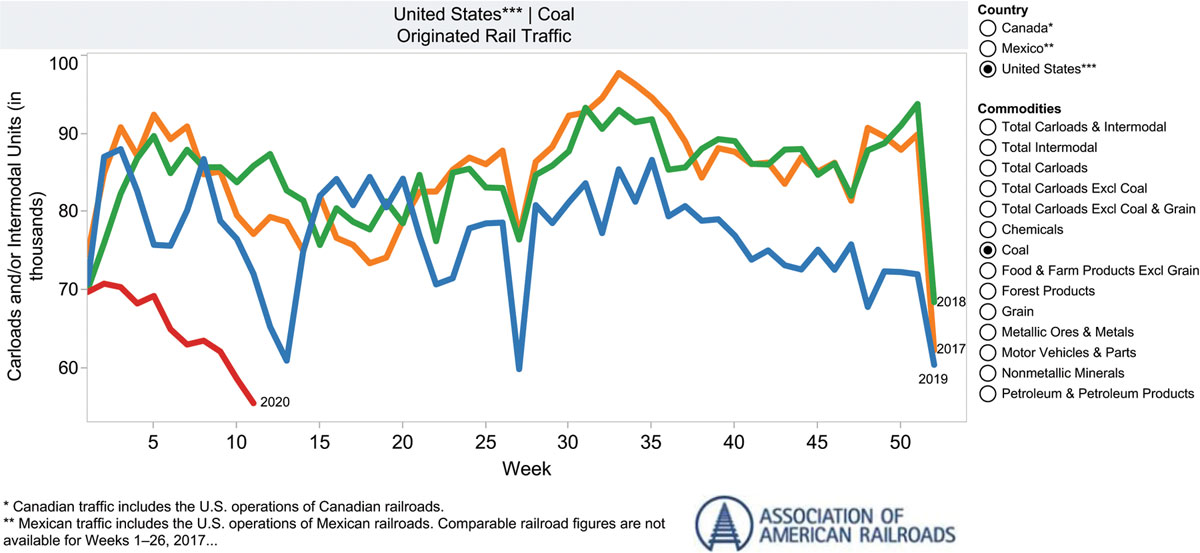
And it isn’t just coal, other bulk and liquid commodities are down as well. With oil dropping to the $30 a barrel range as Saudi Arabia and Russia square off for global market share in oil, higher priced US and Canadian oil (largely shale oil) is compelled to sit on the sidelines. The cheap oil and gas (which means competition from pipelines) also means that power plants are less likely to buy coal, pushing demand even lower. The good news is that fuel expenses are also lower, but the offset to traffic loss isn’t sufficient.
For a little insight, it’s worth looking at UP’s annual results for 2019. For the year UP reported a net income of $5.9 billion, a one-percent decrease over 2018. What’s interesting is freight revenue totaled $20.2 billion, a 5% decrease to 2018, while carloadings were down 6% versus 2018. The reason for the decline was “growth in industrial volumes more than offset by fewer agricultural products, premium and energy shipments.” So, despite a best ever OR of 60.6%, a decline in bulk volumes flattened the bottom line. With fewer carloadings in the future and likely a different mix in commodities, what will the bottom line look like in 2 years, 5 years or ten years from now?
It’s an industry trend that throws into question just how far the PSR strategy will take the railroads.
PSR 2.0
The economic headwinds aside, technologically, trucking is in the midst of making significant strides that will improve the ability for the sector to compete (or partner) with rail. The impact of other technologies, specifically a wide range of automated ‘drone’ delivery systems, have the potential to truly alter the landscape of North American transportation.
In Taking the Railroad Playbook Beyond PSR, the authors suggest “Improve operations effectiveness by applying digital technologies and advanced analytics. Railroads can use digital technology—such as Internet of Things applications—to enhance the reliability and traceability of goods and railcars and to integrate their traceability and tracking with other transport modes.” They also suggest using “predictive analytics to reroute assets more dynamically and increase speed.” Interestingly, CN (among others) is already moving in that direction: “Data is the new currency, proving to be the most important strategic asset… The future is now. As we evolve from a traditional railway to the digital connected railway of the future, next generation technology algorithms designed to provide real time information to our crews and customers are laying the foundations of the digital connected railway.”
The Post PSR study also suggests railroads, “Rethink core commercial functions by digitally managing pricing and demand. Across the value chain, logistics players are radically changing their go-to-market strategies. In part, they are being pushed to do so by highly innovative players such as Amazon, eBay, and Walmart. These innovative companies use more sophisticated buying practices that require faster quote turnarounds.”
Will railroads operate more like integrators in the future? Certainly, some railroads have already begun developing a tech-based post-PSR strategy. But will the industry be able to keep pace with economic, socio-political and environmental changes of the new roaring 20’s…and turn a profit?


