
Auto measures could hit market hard
On June 8, President Donald Trump suspended the tariffs he had threatened on all imports from Mexico, a move that could have wreaked havoc on Mexico’s manufacturing sector and the North American auto business generally. The automotive sector in Mexico relies heavily on vehicle exports to the United States, accounting for more than 17% of all of Mexico’s manufacturing, while the United States auto industry relies on an integrated North American supply chain for its profitability.
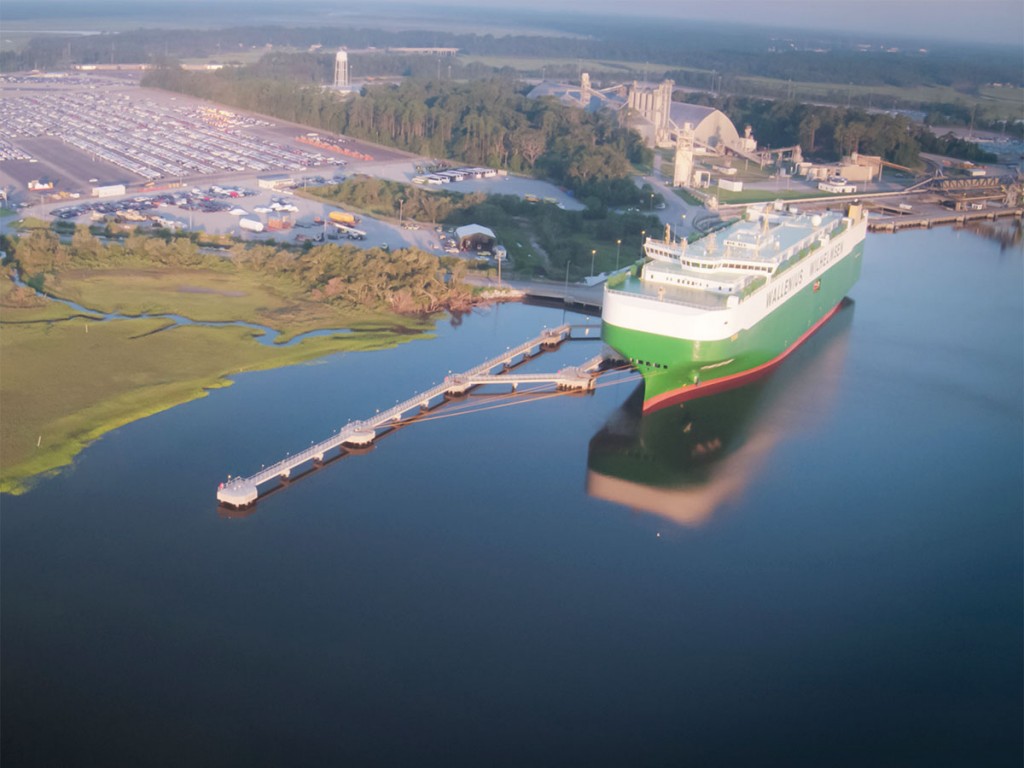
Big Ships Keep Ro/Ro Rolling
The Port of Baltimore recently announced it set several new records in March, including the best March on record for cars and light trucks, at 59,052 vehicles, and the most roll-on/roll-off farm and construction machinery cargo tons since June 2012, at 96,535. Growing ro/ro numbers like that have been facilitated by investments in recent years in much larger vessels on the part of ro/ro carriers—much like their container counterparts.
The largest Pure Car and Truck Carrier (PCTC) ship in the world is the Höegh Target, with a capacity of 8,500 CEUs (car equivalent unit). The Wallenius Wilhelmsen Logistics’ HERO (High Efficiency Ro/Ro) class vessels boast a capacity of around 8,000 CEU. Both were built to exploit the possibilities of the expanded Panama Canal, which opened in 2016.
Much as container carriers have begun to deploy mega-ships that the new locks can accommodate, so have vehicle and equipment carriers followed suit. But, just as some have questioned whether container lines should have invested in oversized ships, the wisdom of the ro/ro carriers will also be questioned in the event of a slowdown in the vehicle trades—especially in the era of the Trump tariff.
Vessel size is not the only resemblance between the container and ro/ro businesses these days. Both fleets suffer from an overcapacity that has led to downward pressure on rates, and that has turned up the heat on competition. In today’s environment, container carriers are competing not only with each other but with bulk and breakbulk carriers as well. Many ro/ro carriers, too, are competing for a diversity of cargo, including breakbulk and lift-on/lift off (lo/lo) shipments.
“Larger vessels figure into the equation the same way they do for container carriers,” said Frank Camp, director of non-containerized sales at the Port of Jacksonville. “They are trying to lower the cost per unit so the carriers are going as big as they can. If they are sailing ships with more capacity they can potentially deliver more cargo.”
“In the breakbulk market, ro/ro competes with container vessels, heavy lift, and multi-purpose vessel types,” added Simon White, head of trade management ocean operations at Wallenius Wilhelmsen Logistics, “all of which are experiencing their own issues related to overcapacity. WWL has invested heavily across its entire fleet to be able to provide extended capabilities for breakbulk cargo.”
The Mexico Factor
The growth of auto production in Mexico provided a new source of business for ro/ro carriers and ports, and, because of recent developments, is very much on their minds. Not only do they have to worry about the disruption caused by potential Trump tariffs, but also from competition from rail, especially in the face of higher shipment costs.
Ports America handles approximately 2.5 million import and export units annually in 14 auto and ro/ro ports servicing many markets—the largest being Japan and Western Europe. But the most notable change the company has seen recently has been “more short-sea spot shipments than normal out of Mexico,” said Luke Doremus, Ports America’s national account manager for ro/ro. “We have worked several unexpected new car import operations in Tampa in recent months.”
Ports America’s auto volumes have remained flat between May 2018 and May 2019 and down slightly since 2017 across all Ports America locations. “Heavy equipment, breakbulk, and static cargo volumes have increased during the last several years,” noted Doremus.
Thus far, the company has not experienced an impact at the ports due to the tariff disputes. “However, we believe a decline in volume is possible in the future if tariffs take effect,” said Doremus. “Additional costs to OEMs will pressure logistics networks, forcing OEMs to cut costs where they can. Rail is generally less expensive than short sea and may begin to draw a higher allocation of import cargo from Mexico.”
Mexico was very much of concern recently to Lynn Baltz, vice president of southern operations at JF Moran, a woman-owned logistics company, as trade with Mexico would have been impacted if the tariffs had gone into effect. JF Moran’s main trade lanes connected to Jacksonville currently are the Middle East, South America, Central America, and Mexico, with the majority of shipments handled being either factory-new vehicles or previously-owned units.
“Although we have not seen any recent changes in the services offered from Jacksonville,” said Baltz, “I’m sure that as more tariffs are imposed and as countries that were eligible for duty free treatment under the Generalized System of Preference are taken off the program, there will be changes.”
Meanwhile, there are other factors which could have an impact on ro/ro trade with Mexico, including the possibility of the USMCA, the replacement for NAFTA, coming into force. (See sidebar on page 9) “We don’t think the USMCA will have an unduly negative impact,” said Roberto Zavala, vice president of Mexico operations at WW Solutions. “The underlying conditions for manufacturing vehicles in Mexico are still extremely favorable. A slowdown in the North American economy would have a much bigger impact on the Mexican automotive industry.” As would, no doubt, new U.S. tariffs on all auto imports.


