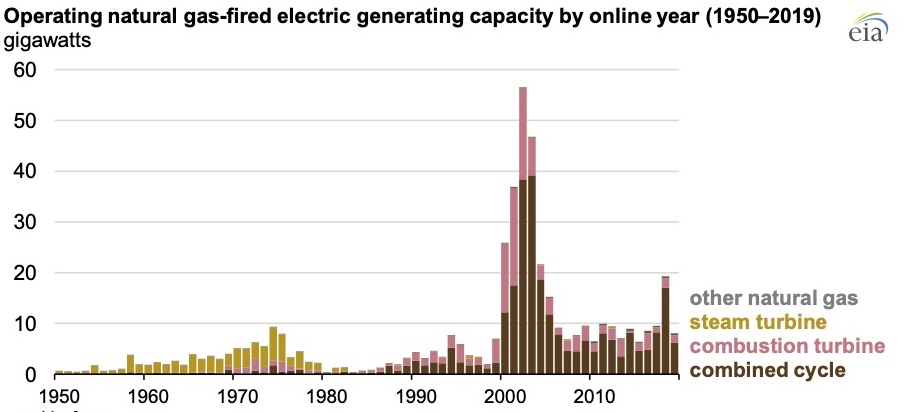
Based on the U.S. Energy Information Administration’s (EIA) annual survey of electric generators, natural gas-fired generators accounted for 43% of operating U.S. electricity generating capacity in 2019. These natural gas-fired generators provided 39% of electricity generation in 2019, more than any other source. Most of the natural gas-fired capacity added in recent decades uses combined-cycle technology, which surpassed coal-fired generators in 2018 to become the technology with the most electricity generating capacity in the United States.
Combined-cycle generators generally operate for extended periods; combustion turbines and steam turbines are typically only used at times of peak load. Relatively few steam turbines have been installed since the late 1970s, and many steam turbines have been retired in recent years.
Not only are combined-cycle systems more efficient than steam or combustion turbines alone, the combined-cycle systems installed more recently are more efficient than the combined-cycle units installed more than a decade ago. These changes in efficiency have reduced the amount of natural gas needed to produce the same amount of electricity. Combined-cycle generators consume 80% of the natural gas used to generate
Every U.S. state, except Vermont and Hawaii, has at least one utility-scale natural gas electric power plant. Texas, Florida, and California—the three states with the most electricity consumption in 2019—each have more than 35 gigawatts of natural gas-fired capacity. In many states, the majority of this capacity is combined-cycle technology, but 44% of New York’s natural gas capacity is steam turbines and 67% of Illinois’s natural gas capacity is combustion turbines.


