
The Latin American Decade never quite took hold. The U.S.-China trade war is both an opportunity and a threat while the region’s trade pacts all face challenges that could mark their undoing. But a new decade is approaching, will the region be ready for another bid?
In July, China’s Foreign Minister Wang Yi made the rounds visiting various Latin American capitals. The purpose of the tour was transparent to all - China’s willingness to trade without conditions. At a stop in Brazil, Wang remarked to the gathered press corps, “the most distinctive characteristic of China-Latin America cooperation lies in equality and respect. When the Chinese side cooperates with its Latin American friends, it always treats each other equally and takes care of each other’s core and major interests. It always sticks to respecting their political systems and development paths and not interfering in others’ internal affairs…”

It’s not surprising the U.S. and China are on opposites sides of the Venezuelan imbroglio as the two economic giants rarely find agreement in the political arena. Still, the barbs that Wang Yi and Mike Pompeo have proffered on their respective trips through Latin America and the Caribbean (LAC) illustrates the reach and depth of the U.S.-China trade war – literally there are few nations on earth unaffected. And amid the near daily chatter on U.S.-China trade war, Latin America has quietly emerged as a note-worthy secondary front with trade and investment the munitions of influence.
From the LAC standpoint having China as a counterbalance to the U.S. and EU [European Union] is potentially profitable and desirable but there are risks. While the U.S. and China trade dispute has undoubtedly provided some new commercial opportunities for the LAC, the danger of becoming collateral damage in the conflagration is very real – particularly if the quarrel triggers a global downturn which lowers commodity demand and prices.
LAC Trade: Priming the Pump
The title itself for the 2019 Inter-Development Bank’s (IDB) “Trade Trend Estimates” for the LAC succinctly sums up the current situation. The IDB entitled their annual report, The Export Recovery Loses Momentum in Latin America and the Caribbean.
Exports, especially exports to destinations outside the region, have been what primes the economic pump in the Latin America and the Caribbean (LAC) region. When exports boom, every sector of the economy begins to rise. Conversely, when exports fall, the entire economy of the LAC region suffers.

Entering into the 1990s, it was thought (or as the Chilean poet Pablo Neruda wrote a Continent of Hope) in many circles it would be the “Latin American Decade.”
There were many reasons for optimism. It was expected the demand for agricultural and mineral commodities would rise and investment in other commercial sectors, such as manufacturing, would follow suit. The decade hasn’t quite played out that way and LAC exports reflect the unevenness of the global demand for commodities.
Still there was a recent upswing in 2017 that spilled over into 2018 that gave rise to the hope that it was just a matter of a little more time for the LAC’s monumental decade.
According to the IDB report (the IDB is a primary source of multilateral financing in Latin America), the total value of exports from the LAC grew at around 9.9% in 2018. In 2017 exports grew a robust 12.2% and reached $1,077 billion buoyed by strong commodity prices. Equally the slowing of export growth in 2018 was largely attributed to weak pricing. It is worth noting in the period covered January-to-September global trade grew by 11.6% compared to the 9.9% notched in the LAC.
However, the export numbers for the entire LAC are a little deceptive as Mexico’s exports have continued to boom (even with contentious NAFTA-USMCA negotiations). As the IDB points out, only Mexico and Chile exports really improved in 2018. Mexico exports were up 8% in 2017 and 9% in 2018. And Chile rebounded from a -2% drop in 2017 to an increase of 7% in 2018.
As commodities represent an inordinate share of the LAC exports, global demand and pricing has a large say in the performance of many LAC economies. The LAC’s extractive industries and agriculture make up a bulk of the export mix. For example, oil, iron ore and copper are big extractive items while sugar, coffee and soybean are major agricultural exports.
Back in 2011-2012 a boom in commodity prices boosted the LAC and gave credence to the Latin American decade discussion.
But prices now are considerably lower as the IDB estimates indicate…with no immediate recovery at hand.
Iron ore (November 2018) was off 62% from the high in 2011 [August 2019, $93.07 compared to February 2011, $187.18]. Copper is also off (November 2018) 39%, compared to 2011 [September 2019, $2.63 compared to February 2011, $4.54]. Sugar also has taken a hit and is down 60% (November 2018) from the record in 2011 [Dec. 2010 $0.32 compared to Sept. 2019 $0.11]. Soybeans exports have also fallen from an August 2012 high of $17.58/bushel to an August 2019 tally of $8.43/bushel.
The exports of soybean are particularly indicative of the secondary impact of the trade war as China is a major soybean importer, the U.S. a major supplier to China and a number of LAC nations like Brazil and Argentina competitors to the U.S. in the China market.

Enter (or Exit) the Dragon
Last year, then-candidate right winger Jair Bolsonaro in the run up to the Brazilian presidential elections accused China of trying to buy the election. But after winning the office, President Bolsonaro became far more circumspect about his country’s relationship with the world’s second largest economy. Brazil is on its way to becoming the world’s largest soy exporter – surpassing the U.S. – largely because of China’s shift to Brazilian soybeans. In 2018 Brazil exported just over 66 million tons of soybeans to China amounting to around 75% of the PRC’s total imports – up nearly 30% over 2017. Conversely the U.S. supplied 16.6 million tons of the soybeans, down a staggering 49% from a year earlier.
The tariff war bonanza has put pressure on South American growers to keep pace with China’s demand. Soybean suppliers in Argentina and Brazil are worried that they will fall short and China will look to other trade partners to fill the void. In early September, Argentina’s agricultural minister announced an agreement for “soy meal” as opposed to simply raw soybeans. For Argentina, building soybean processing facilities is a big win providing China remains a buyer.
And That’s the Rub
On September 30th Reuters reported Chinese firms bought up to 600,000 tons of U.S. soybeans for shipment from November-to-January. The purchase is part of a tariff-free quota of two-million tons allocated to Chinese importers [by the Chinese government] ahead of the upcoming U.S.-China trade talks.
If China and the U.S. were to reconcile their trade quarrel – where would that leave Argentina, Brazil and indeed the rest of LAC?
A Fire is Lit: Trade Pacts in Danger
The LAC region is member to some 35 international trade agreements. Pacts whose primary goal is aimed at reducing tariffs and encouraging trade. A majority of these pacts are intra-regional but trade within the LAC has never manifested itself to the same degree as trade to Europe, the U.S. and now China.
This is reflected in the rival trade pacts. The region’s largest trade pacts Mercosur, the Pacific Alliance and NAFTA [USMCA] are all undergoing major challenges that ultimately could reshape the patterns of trade in the region.
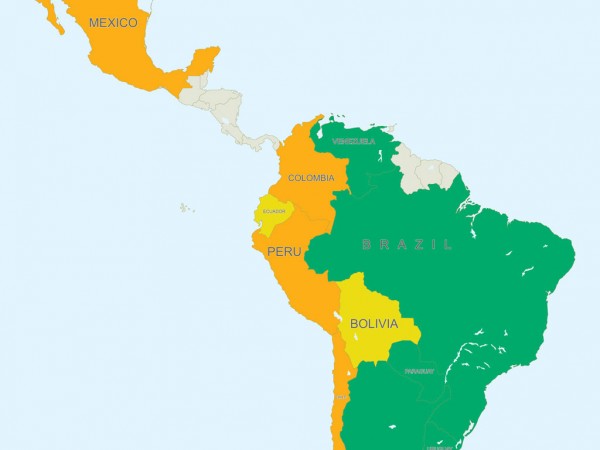
Take the Mercosur pact as an example. In Mercosur, [Argentina, Brazil, Paraguay and Uruguay] there is a widening gulf of interests between the member states. Brazil and Argentina, the two largest economies in Mercosur, are rapidly moving in divergent directions that could cause a ruinous rift in the pact.
Brazil’s right wing populist President Jair Bolsonaro has initiated talks on a bilateral trade agreement with the U.S. counting on his relationship with President Trump to push the process along. He has also initiated formal trade talks with Mexico. With the June ratified [but not signed] USMCA agreement, Brazil envisions a trade agreement with Mexico and the U.S. as a way to directly and indirectly profit from the future USMCA market.
But then there is the Mercosur-European Union pact that is awaiting to be ratified.
The EU deal is important to Bolsonaro and Brazil. The EU is Brazil’s second largest trade partner (behind China) accounting for over 18% of the total. The pact could make a big difference in exports such as beef. If the pact is approved, it would also reduce to zero from 20% the duty on beef imports into the EU. And Brazil’s exporters see the pact not only for its own sizable merits, but as a springboard to deals with other nations like the Philippines, Thailand, Indonesia, Mexico and of course the U.S.
After two decades of negotiations, Bolsonaro wants the EU-Mercosur pact to be ratified [as does the leadership of the other member nations] but the Amazon wild fires have fueled resistance among some EU nations to endorsing the trade pact. Bolsonaro turned down more than $20 million in aid money offered by G-7 nations to battle the fires. As a result, France and Ireland announced they would not ratify the EU-Mercosur pact and in Austria.
A subcommittee of the parliament voted down the pact. Since the pact requires all EU members to agree the twenty years of negotiations appear wasted because of Brazil’s stance.
And then there is Argentina’s situation. The country is in danger of defaulting on IMF [International Monetary Fund] loans, inflation is running at a staggering 50% and there is an election looming on October 27th, which most pundits think will result in a new administration.

Argentina’s President Mauricio Macri’s market oriented policies have seemingly failed and leftist Peronist candidate Alberto Fernandez seems poised to win. Back in August, Bolsonaro’s Economy Minister Paulo Guedes said Brazil would pull out of Mercosur if Fernandez should win. In Argentina, Fernandez has already taken a pro-protectionist stance and said he would reject the EU-Mercosur pact. A Fernandez election inserts a great deal of uncertainty. Will Brazil and/or Argentina leave Mercosur? Either way, it would severely damage the trade group. Will the IMF and Fernandez agree to a deal to handle the debt? The IMF is described as a “lender of last resort” and should Argentina default where else could it go for financial assistance? China is the obvious answer but as Pompeo pointed out it could well be a “debt trap”.
Mercosur isn’t the only LAC pact in trouble. The Pacific Alliance cohesion will be tested with the political turmoil in Venezuela and now Peru. Even the USMCA agreement will face challenges to the signatory process in the U.S.

Promising Outlook in Unpromising Times
Recently, Descartes Datamyne, a company supplying global economic information – released a timely report, “The Promising Outlook for the Latin American Markets Moving Into 2019.” (The introduction noted that even within the challenges there is “Hope” for the LAC, “The markets for Latin America are driven by global trends, domestic economic factors, and shifting political environments. Growth in 2019 is expected to be among the weakest of all the major regions, largely due to an ongoing recession in Argentina and the major economic and political crisis in Venezuela; however, looking into specific industry verticals even in these struggling economies shows growing opportunities…”
Despite the unpromising economic outlook, a number of sectors continue to grow. It’s easy to run through Datamyne’s research stats and find imports and export sectors that are doing well such as grapes in Chile or soybean and soy product shipments from Brazil and Argentina. Mexico’s auto business is still going strong and while wood pulp and related products from various LAC nations are doing well. The Economist in a recent study of the LAC highlighted the Fintech and Renewables sectors, both of which are thriving in the LAC.
And then there is the fact that when this period of trade war passes, [and it will] the LAC will again be by virtue of the abundance of resources and market again poised for a renewed effort to craft a “Latin American Decade.”
s


