

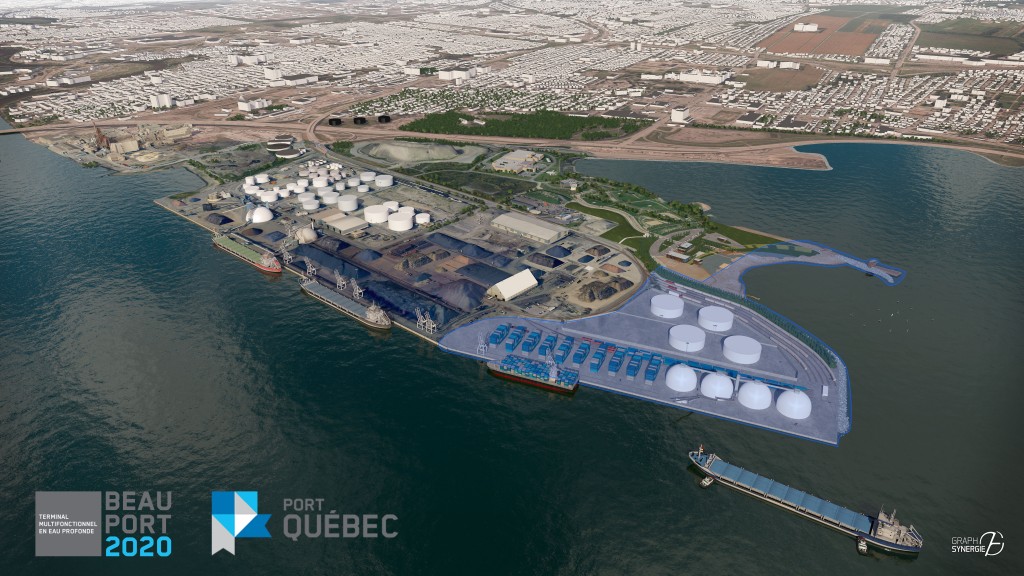
The Québec Port Authority (QPA) today announced the signing of a long-term commercial agreement with Hutchison Ports and Canadian National Railway to build and operate a new C$775 million container terminal, known as project Laurentia (previously Beauport 2020).
Hutchison eyes the terminal as its “gateway to the East Coast of North America,” commented Eric Ip, Group Managing Director of Hutchison Ports. “With its fully intermodal deep-water port, its strategic location to reach the Midwest market, and the strong support shown by the local authorities, the Québec project has all the attributes to be successful in this highly important market.”
Mario Girard, QPA President and CEO, made his prime objective clear: “allowing the St. Lawrence to gain additional growth and competitiveness with US ports” on the East Coast that have expanded capacities to accommodate the new generation of large container vessels.
The project is widely seen as a challenge to the longstanding dominance of the Port of Montreal in the North Atlantic/St. Lawrence trades. Due to draft limitations, Montreal can accommodate vessels of just 5,000 TEUs fully loaded. With water depth of 15 meters at high tide, Quebec can handle containerships above 10,000 TEUs.
But from the outset, some industry consultants have expressed skepticism over the viability of the Quebec project despite the global mega-ship trend. Canadian consultant Brian Slack last year notably underlined the strengths of the Montreal Model. “What is striking about Montreal is the full discharge and load: you are typically bringing 4,000 in and taking 4,000 containers out. Now that is as good as you are going to get on any US East Coast port where vessels make multiple stops.”
The news was not unexpected following the port’s hiring last year of Don Krusel as the key adviser for a project that took St. Lawrence maritime circles by surprise when it was first unveiled in late 2017. Formerly chief executive of the Port of Prince Rupert, Krusel was the architect of the significant transformation of the remote port in northern British Columbia into arguably the fastest-growing container port in North America.
The agreement increases Hutchison Ports’ global network to 52 ports spanning 27 countries including the United Kingdom, Spain, Poland, Sweden, Germany, the Netherlands, Belgium, Australia, China, Pakistan, Egypt, Argentina, Mexico and Panama. Hutchison Ports plays a strong role in the maritime industry worldwide and handles close to 85 million TEU (twenty-foot equivalent unit) per year, representing approximately 11% of the global containerized cargo trade.
The project will be financed primarily through the joint investment of the three partners. The QPA also has ongoing discussions with the federal and provincial governments to complete the financing. The new terminal facility will support hundreds of new jobs at full operations. Hutchison Ports was selected after a competitive process in which QPA invited the leading international port operators to provide proposals to participate in the project.
The agreement stipulates that Hutchison Ports will build the most environmentally and technologically advanced cargo-handling facility in North America.
“In an economy driven by consumer spending derived freight, long haul supply chains need to be modern, cost effective and reliable. Hutchison is a world class container operator and we are confident that we are partnering with a group that can make the project a success,” said JJ Ruest, President and Chief Executive Officer of CN.
With the project reaching a pivotal milestone, the Québec Port Authority said it is using the opportunity to unveil the new brand image for its Deepwater container terminal. In reference to the North American continent’s genesis, the project is thus henceforth known as Laurentia, reflecting the continental reach and importance of a new container terminal on the Saint Lawrence.


